
Where creativity meets science - the underpants dress
Our Approach
The Underpants Dress is a contemporary artwork that transforms a citizen-science experiment into material form. Constructed from cotton underpants buried and decomposed as part of the Swiss soil-health initiative Proof by Underpants, the dress carries the physical imprint of microbial activity. What is normally invisible - soil life, microbial activity, fungal hyphae - becomes the fabric itself.
-
The work draws selectively on Rococo codes but redirects their historical excess toward ecological awareness. These historically lavish forms are placed in direct contrast with biologically altered textiles shaped by microbial activity and material degradation. Rococo is used here as a historical framework, a reference to one of the earliest cultural systems built around visibility and consumption. The Rococo era (roughly 1730-1780) coincided with a court culture in which display, visibility, and performative social distinction were central mechanisms of power. Garments signalled rank, wealth, and leisure. Marie Antoinette, through her patronage of Rose Bertin and her exceptional spending, became a powerful engine of trend acceleration and public attention to appearance. It was an early example of what we might now call fashion-driven visibility culture and begun to normalize an aesthetic logic in which garments were increasingly detached from material origin and ecological cost. In this inversion of the Rococo model the dress redirects that spotlight toward soil health, transforming a historical language of display into a contemporary communication about ecological awareness addressed to society at large, including but not limited to the fashion industry’s dependence on living systems. The work situates glamour within cycles of soil activity, turning couture into a tool for education and awareness. In this way, art, fashion, and science operate together: a contemporary experiment where Rococo ornament is only a reference, and soil itself is the true subject.
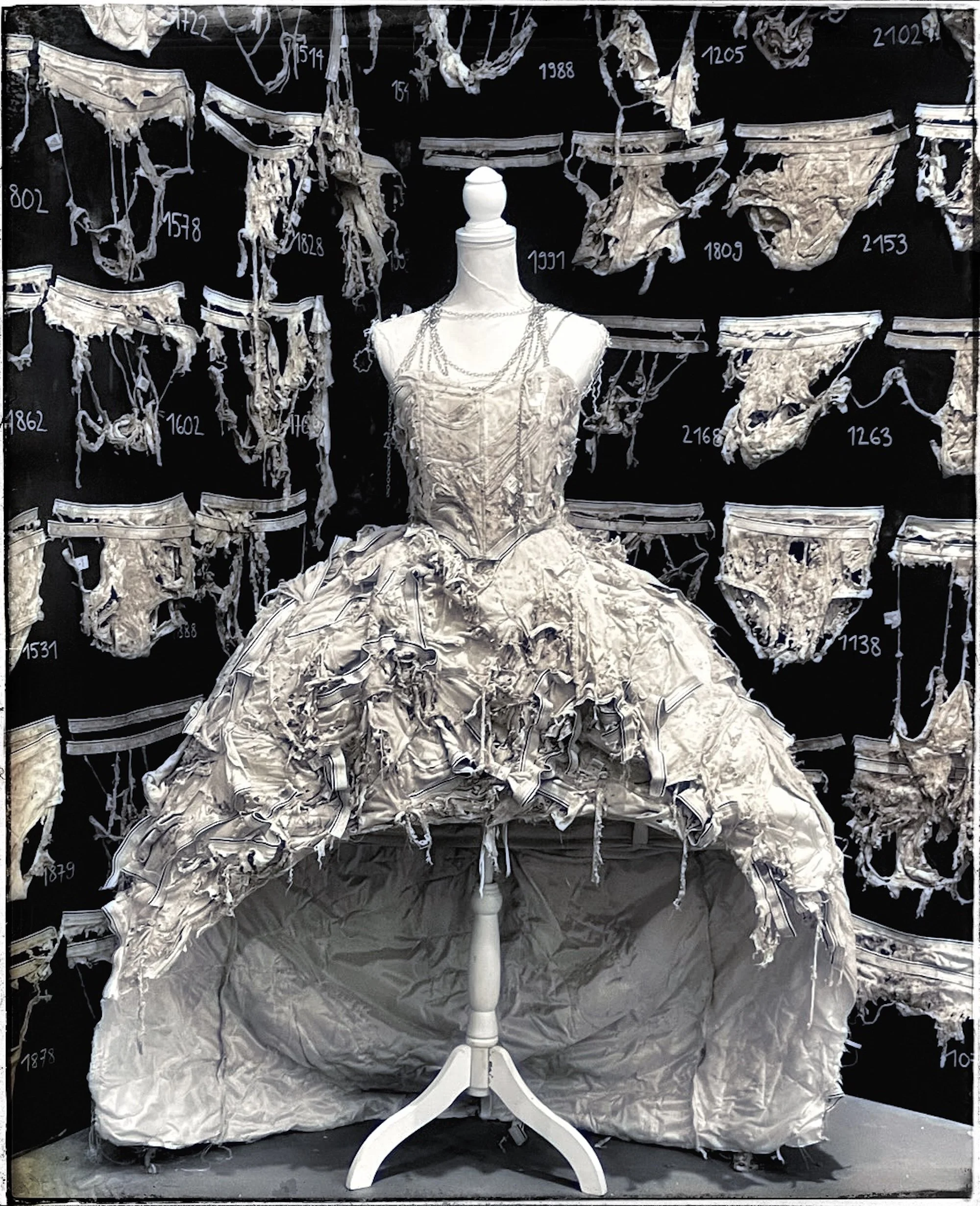
The Underpants Dress was developed to translate soil health into a tangible, wearable medium. The design intentionally uses cotton underpants decomposed in Swiss soils to expose the biological processes normally hidden beneath the surface. The goal was not only to materialize soil vitality but to employ fashion for its semiotic power - its ability to communicate, provoke inquiry, and make scientific processes immediately legible to a broad public. While the spectator asks “What is this?”, the garment has already begun its work of transforming scientific data into cultural understanding.
A journey of transformation and giving back
-
The construction preserves the decayed structures shaped by microbial activity, allowing the material’s transformation to determine form rather than submitting to conventional aesthetics. Rococo-inspired volumes were chosen as a structural framework precisely because their historical association with excess contrasts with the rawness of decomposed textiles. This contrast is used to interrupt habituated perception. It prompts the viewer to reconsider what is normally overlooked, making microbial processes and mycelial activity visible. The persistence of synthetic components - such as the rubber waistband, seams, and label - is intentionally retained to demonstrate their resistance to soil processes and their differing ecological impact. The intent is to use contrast not for aesthetic effect but as a functional tool to reveal soil dynamics, material behavior, and the implications of material choice for ecological systems.
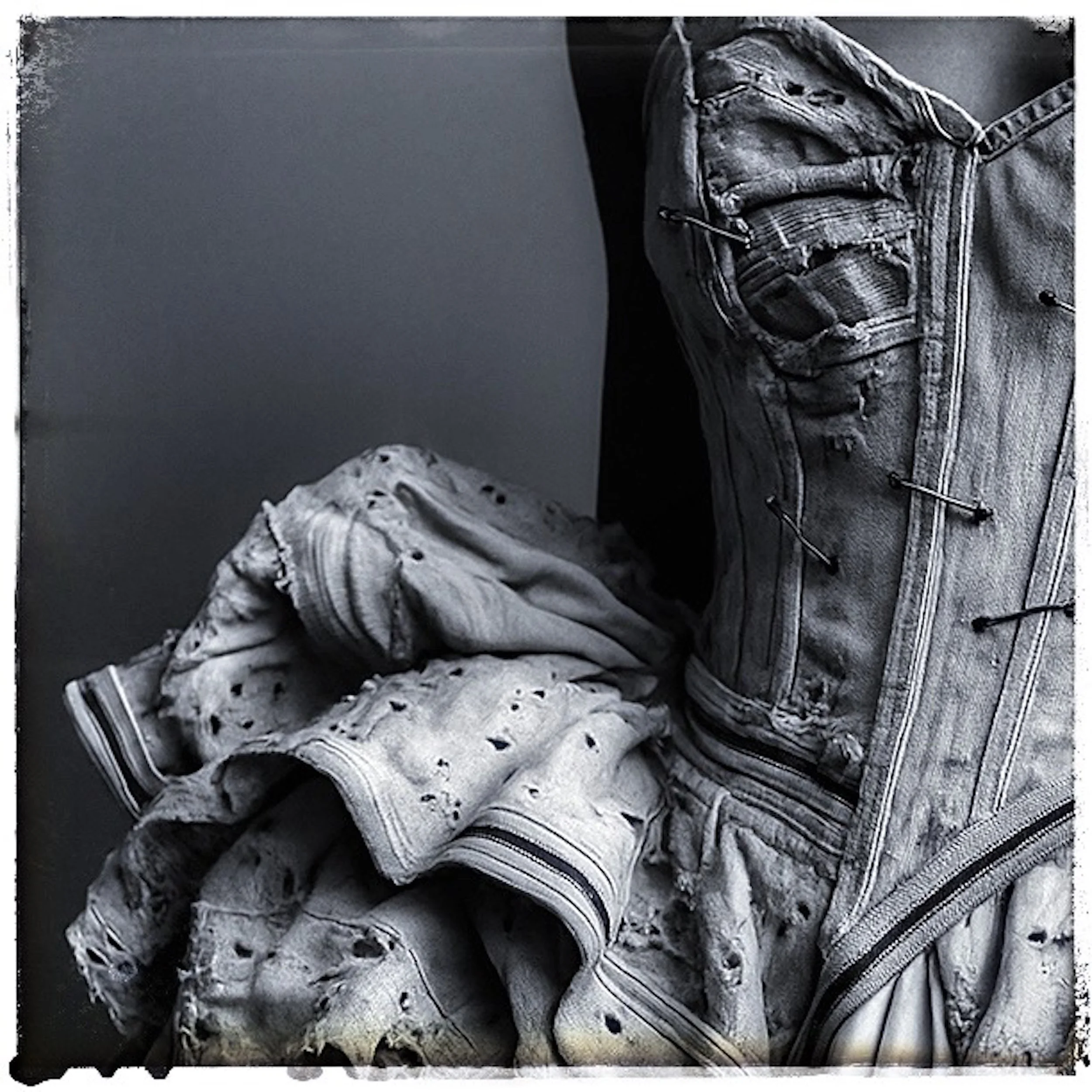
The project uses cotton underpants that were biologically altered through Agroscope’s citizen-science soil-health experiment Proof by Underpants, co-led by soil ecologists Marcel van der Heijden and Franz Bender. For scientific consistency, the researchers employed only new, originally packaged, organic cotton underpants, ensuring comparable starting conditions across all soil sites. The textiles are integrated into the garment in their post-soil state without aesthetic correction, allowing microbial, mycelial, and environmental effects to determine their surface condition. A deadstock silk taffeta serves as the base material onto which the soil-altered textiles are sewn, providing structural stability while maintaining material responsibility. The silhouette is supported by a self-constructed pannier construction, reinforced with metal components, to maintain Rococo’s characteristic spatial proportions and support the garment’s substaintial weight which conventional panniers could not structurally support.
material
-
Synthetic components of the underpants - such as the rubber waistband, seams, and labels - are intentionally retained to show their resistance to soil processes.
Additional structural components are minimized to preserve the integrity of the altered fabric and to maintain a direct connection to the soil-testing methodolgy from which the material originates. By foregrounding the biological transformations inscribed in the textile, the project positions material behavior as both evidence and design parameter, linking fashion practice to soil health and ecological accountability.
An additional benefit of the project is that the soil-altered underpants, which would normally be discarded after the experiment are repurposed rather than wasted. Scientific residue got transformed into a semiotic tool that communicates soil health, extends citizen science, prevents waste, and reframes material data through design.

Soils form the basis of our civilization, but they are under threat worldwide. Climate change and intensified land use are putting pressure on soil fertility and future food security. Healthy soils provide nutrients, filter water, bind pollutants, and store carbon. They provide 95% of our food and form the basis for a large share of global textile production. These functions can only be fulfilled by a complex interaction of water, air, mineral and organic components, and an immense diversity of organisms in a living soil ecosystem.
The aim of the “Beweisstück Unterhose” (Proof by Underpants) project was to draw attention to this universe beneath our feet and to make the activities of these soil organisms visible with the help of the Swiss population using buried organic cotton underwear. In addition, information about the quality of Swiss soils was collected. The basic assumption behind the project was that the more the underwear decomposed, the more active the soil organisms were and the healthier the soil was.
This project investigated whether this theory can also be scientifically supported. Soil samples and cultivation data were collected to measure soil quality and analyze the factors influencing the decomposition of the underwear and soil quality. As one of the largest and most comprehensive project of its kind to date, the results offer exciting insights into the condition of Swiss soils. The project triggered a worldwide media response – thanks to underpants. Media articles and reports were recorded in at least 26 countries and the project was featured in a range of science and entertainment television shows across Switzerland, Germany and Austria. Through this, attention and awareness for soils as a living, precious, and non-renewable resource could be spread around the globe.