The diamond
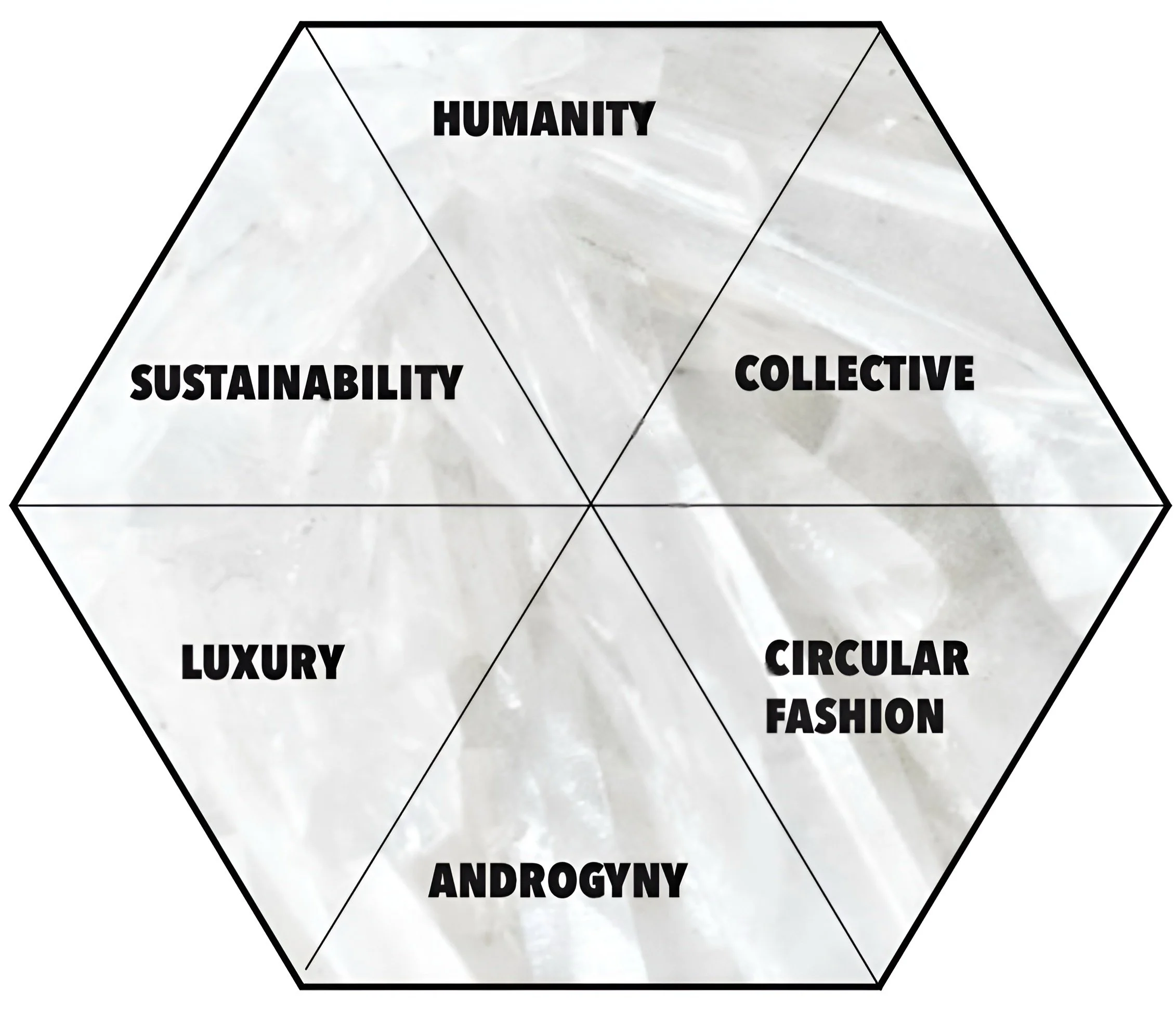
The Diamond Model represents the core philosophy of ELS, built on six essential elements: Sustainability, Humanity, Collective, Circular Fashion, Androgyny, and Luxury. This visual framework encapsulates the brand’s commitment to creating fashion that transcends boundaries - fostering ethical practices, gender fluidity, and a collective spirit while embracing the elegance of contemporary luxury. Each facet of the model reflects ELS’s dedication to innovation and responsibility, shaping a vision for a more inclusive, sustainable future in fashion.
-
HUMANITY
ELS places human dignity at the center of its practice. Garments are developed with respect for the individuality of the wearer and for the people involved at every stage of their creation. From design through production, the studio understands garment creation as a collaborative process grounded in care, responsibility, and human connection. Valuing the people involved is not separate from sustainability, but integral to it.
Each piece tells a story of resilience and courage, transcending cultural and gender boundaries to embrace inclusivity. Fashion becomes a powerful medium of empowerment, reflecting the shared human journey while championing authenticity.
SUSTAINABILITY
At ELS, responsibility toward the environment is treated as a structural obligation. It informs material selection, production scale, labor conditions, and the acknowledgement of ecological limits. Local production in Mendrisio and Zurich, Switzerland, enables close collaboration with manufacturers, operational transparency, and accountable working conditions. Producing locally allows the studio to actively limit transport-related CO2 emissions, reduce logistical complexity, and maintain direct oversight across the entire production process.
All production decisions are guided by an awareness of planetary boundaries - recognizing that natural systems operate within finite limits that cannot be exceeded without consequence. Rather than pursuing growth at any cost, ELS works within made-to-order production in order to minimise resource extraction, avoid overproduction, and reduce unnecessary emissions. Planetary accountability, in this context, is understood as an ongoing practice: one that balances care for people, respect for labor, and responsibility toward the environmental systems that sustain both.
LUXURY
For ELS, luxury is defined by intention and quality. Thoughtfully designed and crafted, each garment embodies timeless beauty and ethical integrity. The brand values fewer, better pieces, combining artisanal detail, comfort, and contemporary innovation to create a luxury that is both meaningful and lasting.
Luxury is defined by the ability to choose restraint, to work within limits, and to invest time, care, and thought into what is made and worn. It values depth and prioritises precision, quality of construction, and continued relevance beyond seasonal and trend-driven cycles.
In this context, luxury is not driven primarily by symbolic consumption tied to visibility, status, or trend cycles. It is the freedom to slow down, to choose coherence over novelty, and to engage with clothing as a lasting relationship. Luxury becomes an expression of responsibility - a conscious decision about where to invest resources, time, and care - supporting local production, sustaining skilled work, and strengthening the networks that make responsible creation possible.
COLLECTIVE
Fashion is a shared journey, one that brings together minds, hands, and hearts. The collective celebrates collaboration across boundaries, uniting artisans, designers, and communities. It is a call to action for shared progress, blending tradition and innovation to co-create garments that honour both individuality and shared purpose.
Artists and researchers contribute to a process based on dialogue, respect, and reciprocal care. Selected garments are developed through exchange with artists and researchers, such as the Underpants Dress, using design as a shared language to communicate artistic and scientific perspectives and create a platform for public engagement.
Collaboration at ELS is understood as a collective practice: a way of learning from one another, strengthening individual expertise through shared effort, and extending the potential of fashion as a tool for connection and for contributing, in concrete ways, to cultural and environmental progress.
ANDROGYNY
Androgyny reflects freedom in fashion - a liberation from gendered expectations. This section of The Diamond envisions garments as fluid expressions of identity, designed to transcend labels. By embracing versatility and individuality, androgyny fosters a world where everyone can feel authentically themselves, clothed in confidence.
Androgyny is understood not as the absence of gender, but as the accumulation of gendered references within a single garment. By drawing from multiple gender roles rather than isolating or negating them, the designs move beyond fixed codes and allow bodies to inhabit clothing and aesthetic expression without prescription and categorisation.
This approach is embedded directly in the design and sizing system of the garments. Through adjustable proportions, flexible construction, and considered volume, pieces are developed to accommodate different body types. Rather than prescribing how a garment should be worn or understood, the design allows the wearer to determine how it integrates into their own life, context, and narrative over time.
CIRCULAR PRACTICE & RESEARCH
ELS operates within a made-to-order model to actively limit overproduction and material waste. Garments are produced in direct response to demand, allowing resources to be allocated deliberately and in alignment with ecological constraints. Deadstock materials are integrated wherever a structurally and materially possible, extending the life of existing resources and reducing reliance on new production.
Material decisions are made at the design stage with the full life cycle of the garment in mind. Wherever possible, the studio prioritises single-material fabrics over blended compositions, enabling easier recycling and more responsible end-of-life processing. Design and production decisions are guided by an awareness of planetary boundaries and by the need to minimise unnecessary CO2 emissions across the supply chain.
This circular approach extends through research and interdisciplinary exchange. Beyond garment creation, the studio collaborates with scientists and research institutions to address soil health, material cycles, and the ecological conditions from which almost textiles ultimately originate. Fashion is used as a communicative medium to translate research outcomes into forms that make these systems tangible and understandable.
Conceptual projects, such as the Underpants Dress and Soil Bodies - The Living Tapestry, developed in collaboration with scientific and research partners including Agroscope, FiBL, and the University of Zurich (UZH), function as research-driven works. These projects communicate the relationship between soil health, textile materials, and decomposition processes, highlighting what happens both before a garment is produced and after it reaches the end of its life. In this context, design serves as a tool to raise awareness and responsibility - for the brand in its material decision, production practices, and for the wearer in understanding the broader environmental systems behind their garments.
©Edie Lou Studio