
fashion and power: the construction of choice
Getting dressed is one of the most personal - and often most difficult - acts in everyday life, if you ask me. It requires constant negotiation: between self-perception and social expectation, between comfort and presentation, between what one wants to express and what can be understood. (Obviously, few of us admits the work put in it. If it looks like effort, it’s over…) Getting dressed is a daily hustle, and it feels entirely like your choice - even though the field of choice was fixed long before. What appears available, desirable, and relevant at any given moment is not the result of spontaneous emergence, but of coordinated industrial processes. The individual does not enter an open field of possibilities, but a pre-filtered system of options. To understand why, we need to step inside the machinery that decides what even makes it onto a hanger.
The fashion industry operates through mechanisms designed to anticipate and shape demand. Trend forecasting, market analysis, and consumer segmentation function as tools that reduce uncertainty and direct attention. Styles are not simply discovered; they are identified, refined, and strategically introduced into circulation. What reaches the consumer has already passed through multiple layers of selection, each determining what is likely to succeed within a given cultural and economic context. These patterns are closely tied to structured patterns of adoption. New aesthetics typically emerge within small, influental groups - early adopters - before diffusing outward into broader markets. As visibility increases, desirability follows. What begins as selective and limited becomes aspirational, then normalized. This progression is not incidental; it is a managed expansion that transforms marginal signals into dominant trends. Consumers select, combine, and interpret, but they do so within a specific framework that has already determined what is available, visible, and legible. Fashion, in this sense, is not only an industry that produces garments, but one that organizes perception, regulates circulation, and structures the conditions under which desire takes from.
Let’s take a closer look at how this system is actually built, how it functions, and how it operates - moving from the initial stages of selection and forecasting to the mechanisms through which certain aesthetics are amplified, circulated, and ultimately normalized. What becomes visible, what is repeated, and what comes to feel familiar, as well as the structures that filter out what does not align anymore. In doing so, the focus shifts from the surface of fashion to its underlying organization, revealing how patterns of adoption, validation, and repetition take shape over time. At the same time, this returns to the individual: how identity is affected by the fashion industry. The shift from the level of the system to the level of the individual, emphasizing that the effects of fashion are not abstract but directly shape how a person sees, chooses, and understands themselves. Identity is not formed in isolation, but within a set of conditions that are already defined. What is available, what is made visible, and what is socially recognized all contribute to shaping how individuals construct their sense of self. At the same time, perception itself is not neutral. Individuals do not simply select from a range of options; they learn to see through what is repeatedly presented to them. Aesthetics that are continuously circulated begin to appear natural, desirable, or correct, while others fall outdside the range of what can be easily recognized or valued. In this way, the system does not only limit choice - it also shapes which choices are made. Consequently, what feels like personal choice remains meaningful but is not entirely independent. Choices are shaped by prior influences, limited by what is available and visible, and given meaning through shared cultural codes that precede the individual. The system, therefore does not completely eliminate agency, but it defines the framework within which agency operates. Identity, perception, and choice are all formed within this structure - and they are never entirely free.
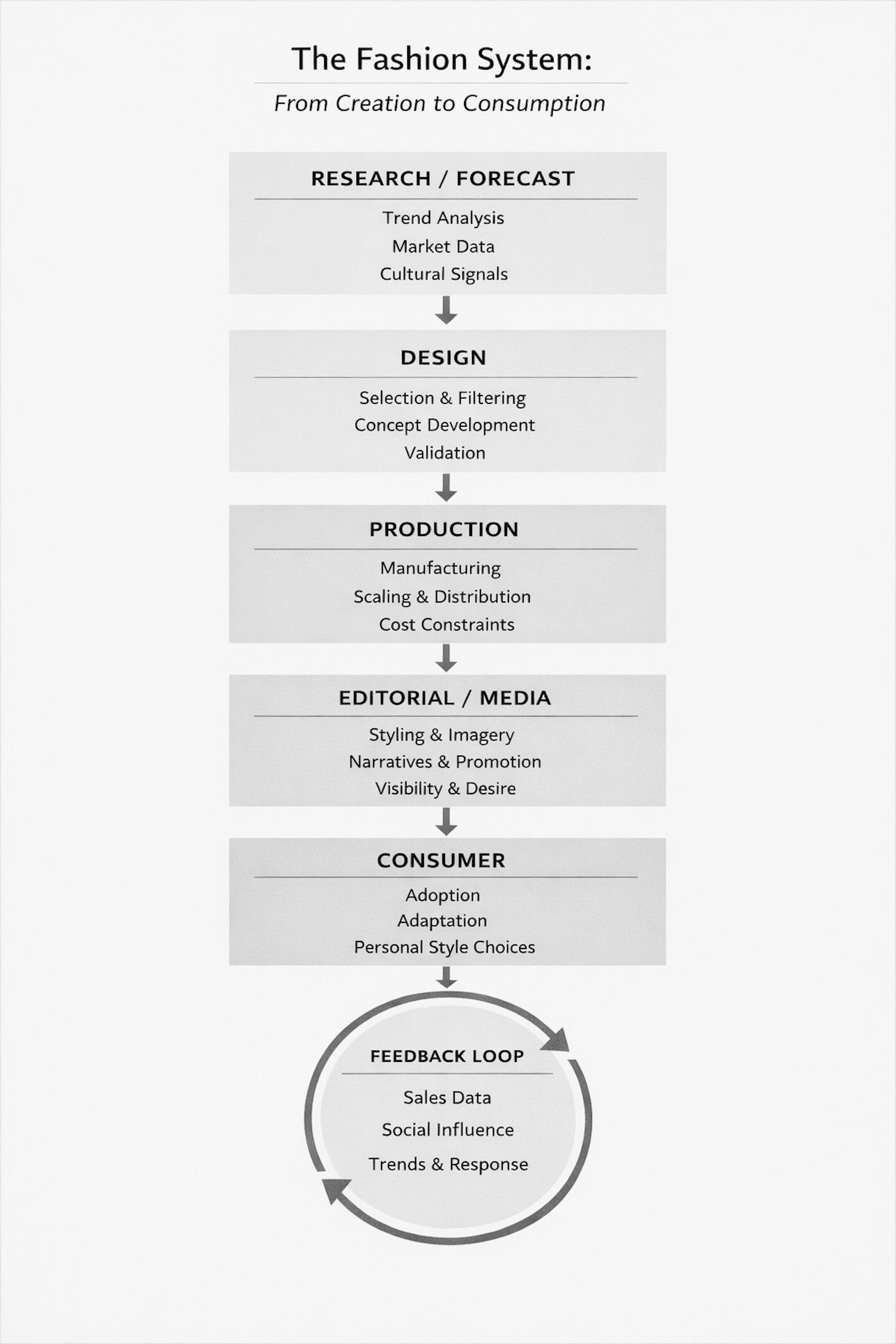
The Fashion System (© Edie Lou Freisinger)
Fashion as a Controlled System
Fashion operates as a controlled system. It does not emerge spontaneously, obviously, but develops through a structured and continuous process that links environment, research, market, and product. At its starting point are broader environmental conditions - economic shifts, political developments, cultural movements, technological innovations, and demographic changes. These conditions do not remain abstract; they produce identifiable shifts in fashion. The global financial crisis of 2008, for example, marked a visible turn away from excess toward restraint, as austerity translated into pared-down silhouettes, neutral color palettes, and a renewed emphasis on longevity and value. A similar dynamic re-emerged in the post-COVID period, where inflation and uncertainty reinforced a preference for durability and understated silhouettes, called “quiet luxury”. At the same time, technological developments - particularly the rise of platforms such as Instagram and TikTok since 2009 - have transformed the speed and structure of trend circulation, compressing cycles into rapid sequences driven by repetition and algorithmic visibility, giving rise to micro-trends that emerge and disappear within weeks. Cultural shifts have also redefined the system, particularly in relation to gender, as we all know it by now. While androgynous and unisex elements have long existed, what has changed is the loosening of the rules that once defined how clothing should be worn. Boundaries around what is considered masculine or feminine have become less fixed, allowing for greater fluidity in how existing forms are combined, understood, and integrated into everyday dress.
Political and environmental pressures linked to the climate crisis have introduced sustainability as both an ethical concern and a strategic framework, visible in the adoption of alternative materials, circular production models, and narratives of transparency. Demographic changes further intensify these developments, as the growing influence of younger consumers has accelerated casualization and integrated streetwear aesthetics into luxury codes and context. Taken together, these examples demonstrate how external conditions generate concrete signals that are observed, interpreted, and transformed within the fashion system, shaping not only what is produced but how it is understood and adapted. These external factors generate signals that indicate changing behaviours, values, and aesthetic preferences. Rather than inventing trends independently, the fashion system observes and extracts these signals from the surrounding environment.
The system then applies a further level of control through market evaluation. Consumer research, competitive analysis, and sales records are used to assess which directions are viable.This stage acts as a filter: not all identified patterns are developed into products. Instead, only those that align with market demand and economic feasibility are selected. The system identifies many potential directions through research - different colors, silhouettes, materials, or cultural signals. Decisions are based on a combination of data, experience, and comparison. Brands and forecasting agencies collect information from multiple sources: past sales data, which shows what has already performed well; consumer research, which indicates preferences, spending behavior, and lifestyle shifts; and competitor analysis, which reveals what other brands are developing or pushing. Buyers and merchandisers also play a key role, as they translate this information into concrete decisions about what will be ordered, in what quantities, and at which price points. This process, however, is not purely analytical. It also involves interpretation. Patterns are identified across different inputs - for example, a certain color appearing repeatedly across collections, or a silhouette gaining traction across markets. When these signals align with what has previously sold well and what fits current economic conditions, they are considered lower risk. Conversely, directions that are too difficult to sell are filtered out. The system does not predict the future with crtainty, but it narrows down possibilities by favoring what appears most likely to succeed. What reaches the market is therefore not the result of intuition alone, but of calculated decisions based on accumulated evidence, market positioning, and risk management.
The system does not only organize processes, but also controls timing, alignment, and limitation. Fashion operates on extended timelines in which decisions are made well in advance of their appearance in the market. Forecasting, selection, and product development take place months, often years, before garments become visible, meaning that what is eventually presented as “new” has already been defined long before it is encountered by the consumer. In this sense, the system does not simply respond to the present; it actively structures the future. At the same time, these processes do not occur in isolation. The system functions through a high degree of synchronization across its different actors and stages. Similar colors, silhouettes, and aesthetic directions tend to emerge simultaneously across brands and markets, not by coincidence, obviously, but because they are informed by shared data, forecasting frameworks, and aligned interpretations of cultural signals. This creates a coordinated field in which variation exists, but within a relatively narrow range of possibilities. At the core of this system is a process of managing risk. Each stage - research, selection, development, and distribution - is designed to reduce uncertainty and increase the likelihood that a product will succeed in the market. Decisions are not made by exploring all possible directions, but by evaluating which options are most likely to sell, can be produced efficiently, and fit within the brand’s position. As a result, many potential ideas are set aside early in the process. This does not necessarily reflect a lack of creative value, but rather the need to operate within economic and practical constraints. What moves forward is therefore what is considered viable within the system.

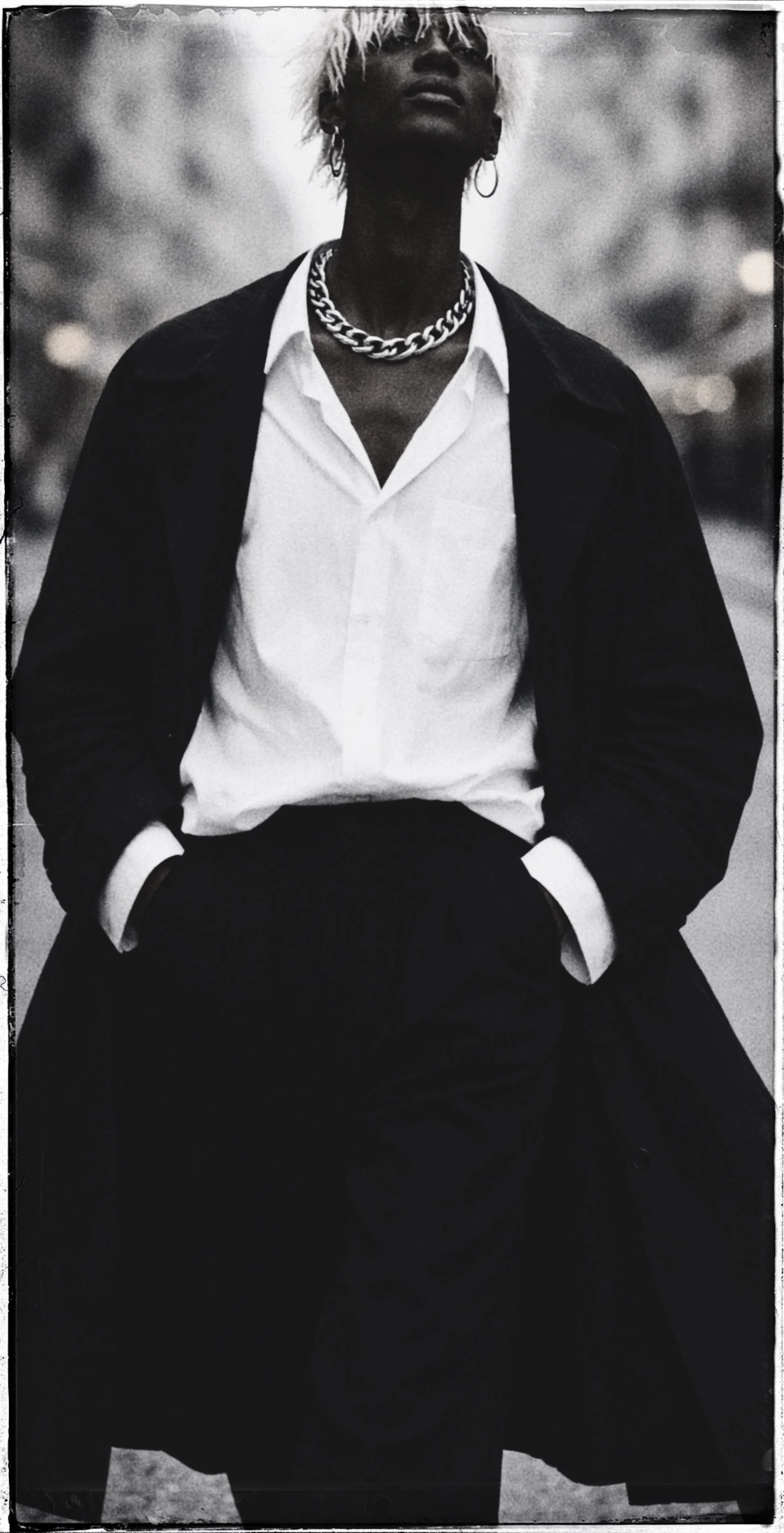
Personal style does exists even if it doesn’t come from complete freedom (© Edie Lou Freisinger)
Power in the Fashion System
Power in the fashion system is not concentrated in a single actor, but distributed across a sequence of roles that operate at different stages of development, selection, and circulation. It functions through a chain in which each participant contributes to shaping outcomes by filtering, selecting, and amplifying specific directions. The system functions as a coordinated chain in which each participant contributes to shaping outcomes through processes of filtering, selection, and amplification. However, this distribution is asymmetrical. Actors positioned at specific stages - particularly those responsible for selection and distribution - have greater influence because their decisions directly determine which products enter the market and which do not. At the stage of development, power is exercised through direction-setting. Forecasting organisations, color institutes, material producers, and designer engage in trend forecasting, defined as the systematic analysis of environmental signals - economic, cultural, technological, and social - in order to identify future directions. These actors operate on extended timelines, typically eighteen to twenty-four months in advance, and translate abstract signals into concrete design proposals. This process establishes the initial parameters of the system by defining which directions will be explored further. In this sense, development functions as a stage of pre-selection.
A more decisive form of power occurs at the stage of selection, which functions as as filtering mechanism within the system. At this point, buyers, retail officers, and editors determine which products move forward into production and distribution. Their decisions are based on factors such as expected demand, economic feasibility, and brand alignment. Through assortment planning, purchasing decisions, and editorial curation, they determine which products are produced at scale, distributed across retail environments, and presented within media channels. Products that are not selected at this stage are excluded from circulation and therefore do not enter the market. So simply said, controlling selection is equivalent to controlling what can be seen and, consequently, what can be chosen. Selection, in this context, is the process through which visibility is controlled. Once a product enters the market, it still has to become visible and recognisable. This happens through promotion and circulation - how they are presented through advertising, editorial features, campaigns, and digital content, and how often and where they appear - across stores, websites, social media, and different markets. The more a product is shown and repeated across these channels, the more familiar it becomes. Familiarity increases recognition, and recognition makes a product appear desirable or “right”. At this point, visibility is no longer just presence - it becomes influence. Media platforms, magazines, and digital actors such as bloggers and influencers function as amplifiers, increasing the visibility of selected products through repetition and validation. As specific aesthetics are consistently presented across different contexts, they acquire meaning and are established as desirable within the system. Circulation, therefore, does not merely distribute products, but actively constructs their cultural significance.
Consumers occupy a different position within this structure. Their role is primarily located at the stage of adoption, which refers to the process by which products are accepted, rejected, or reinterpreted within the market. While consumer behavior influences the success of failure of specific trends, this influence is reactive rather than generative. Consumers operate within a pre-defined set of options that has already been structured through prior stages of development and selection. Their participation confirms or modifies existing directions, but dos not independently determine them. This process has been described in diffusion theory, developed by Everett Rogers, which explains how new products or ideas are taken up over time by different groups of consumers. Through adoption, rejection, or reinterpretation, consumers influence whether specific products gain traction or disappear. When a product is widely adopted, it becomes reinforced and may develop into a broader trend. Conversely, if it is rejected, it is discontinued. This dynamic can be understood as a form of constrained choice or structured consumption. While consumers exercise agency in selecting and combining products, their decisions take place within a framework that has already defined the range of available options. Their influence is therefore limited, operating within the boundaries established by the system.
Ultimately, the question of who acts as the gatekeeper in the fashion system does not resolve to a single individual, but to the point at which selection determines what becomes available. In practice, this position is most strongly occupied by buyers and retail organizations. However, this function is closely intertwined with the role of fashion editors, who shape visibility and legitimacy. Editors exemplify this influence, as their editorial choices frame certain styles as relevant, desirable, and worthy of attention. While editors do not control production directly, they contribute to the process by which selected products gain cultural recognition. So at the end of the day, Anna Wintour or Chloé Malle won’t tell you what to wear - but they will decide what is worth seeing in the first place. And once something is seen often enough, in the right places, it starts feeling like your own choice.
The DNA of the Dress (© Edie Lou Freisinger)
The DNA of the Dress
What the system produces is not limited to trends, but extends to garments that acquire a stable and persistent position within the fashion landscape. Over time, certain pieces are reinforced through continuous reintroduction and circulation, allowing them to move beyond seasonal change. A garment such as the trench coat is not introduced once and then naturally preserved; it is repeatedly reintroduced each season, in slightly modified version, across different brands and price levels. Through this continuous presence, it remains visible within retail, media, and cultural imagery. Unlike short-lived trends that appear and disappear, these garments do not exit the system. Their ongoing circulation prevents them from being perceived as seasonal. Instead, they come to be understood as stable and reliable options, no longer recognized as trends but as established pieces. In this sense, what appears to be timeless is the result of sustained repetition and continuous availability rather than an inherent quality of the garment itself. Not every garment is able to enter this state.
Only those that meet certain conditions within the system are repeatedly selected and maintained over time. Garments that become established share a high degree of structural stability. Their form is simple enough to be recognized across variations, yet flexible enough to be adjusted without losing its identity. This allows designers to modify details - length, fabric, proportion - while preserving a consistent outline. Because of this, the garment can be updated each season without appearing entirely new or entirely outdated. At the same time, these pieces are considered “safe” because they are already familiar. They have a proven record of acceptance within the market. Buyers and retailers can rely on them. They reduce uncertainty: they are easier to sell, easier to combine with other items, and easier for consumer to understand. Their familiarity lowers the risk of rejection. And of course, in addition, these garments function across different contexts. They are not tied to a specific trend, subculture, or moment, but can be positioned in multiple ways - formal or casual, luxury or mass-market. This adaptability allows them to circulate widely and remain relevant despite changing conditions. Garment such as the trench coat, the white shirt, or tailored trousers are repeatedly selected. They persist because they consistently meet the system’s requirement for recognizability, adaptability, and low risk.
And of course, the way garments develop a stable identity, a kind of “DNA”, over time - is not incidental. When a garment has a strong history, a culturally reinforced narrative, and it is repeatedly selected, reintroduced, and maintained within the system, it undergoes a process of institutionalisation. Through this process, something that was once a specific design becomes stabilized and eventually taken for granted. Closely related is the process of normalization, in which repeated exposure leads to acceptance and expectation. It doesn’t mean that something becomes a neutral standard in a reductive sense. It means that a piece becomes so familiar and so continuously present that it no longer requires justification. Through repeated exposure, it establishes itself as a reference point agains which other choices are understood. It does not lose value; rather, its value becomes embedded and unquestioned.This dynamic is further clarified by the concept of collective selection. Fashion is not random, but shaped through shared processes of selection that stabilize certain pieces over time. If a garment, silhouette, or detail that appears at a specific moment as one possible interpretation among many - a variation that initially exists as one option within a range of possibilities, before it is selected and stabilized within the system - and is then selected, it gradually acquires stability through repetition. It becomes legible, reliable, and culturally anchored. People know how to read it, how to interpret it, wear it, and what it communicates. And once a garment is collectively “selected”, it enters a process of diffusion, spreading through successive stages of adoption, repetition, and stabilization, As it taken up across different contexts and maintained over time, it becomes increasingly familiar and widely recognized within the system.
These processes explain how garments move from isolated designs to established references - and develops its DNA over time. Their codification. A stable set of characteristics that are repeatedly reinforced and easily recognized. And what defines the identity of a garment so clearly that it can be recognized? Well it becomes recognizable when certain elements - such as its silhouette, structure, key details, and its history - are retained over time. Through repetition, these features becomes the identity of the garment itself. Just think about it - long, belted silhouette, double-breasted front, shoulder tabs, a storm flap, and deep functional pockets…we don’t have to name it - we simply know it. But this structuring does not apply to silhouette or form alone. It extends to the narratives through which garments are understood. No garment appears without a story - whether articulated explicitly through branding and marketing, or implicitly through cultural associations, historical references, and repeated modes of presentation. These narratives do no simply accompany the garment; they frames meaning in advance. They define how it is to be read, what is signifies, and how it should be positioned within a broader cultural context. In this sense, the system coordinates not only visibility, but interpretation. A garment becomes desirable because it is embedded within a narrative that renders it coherent and valuable. Sustainability, heritage, innovation, minimalism, luxury - these are not neutral descriptors, but constructed frameworks that guide perception and stabilize meaning. Through repetition, these narratives become familiar, and through familiarity, they become credible.
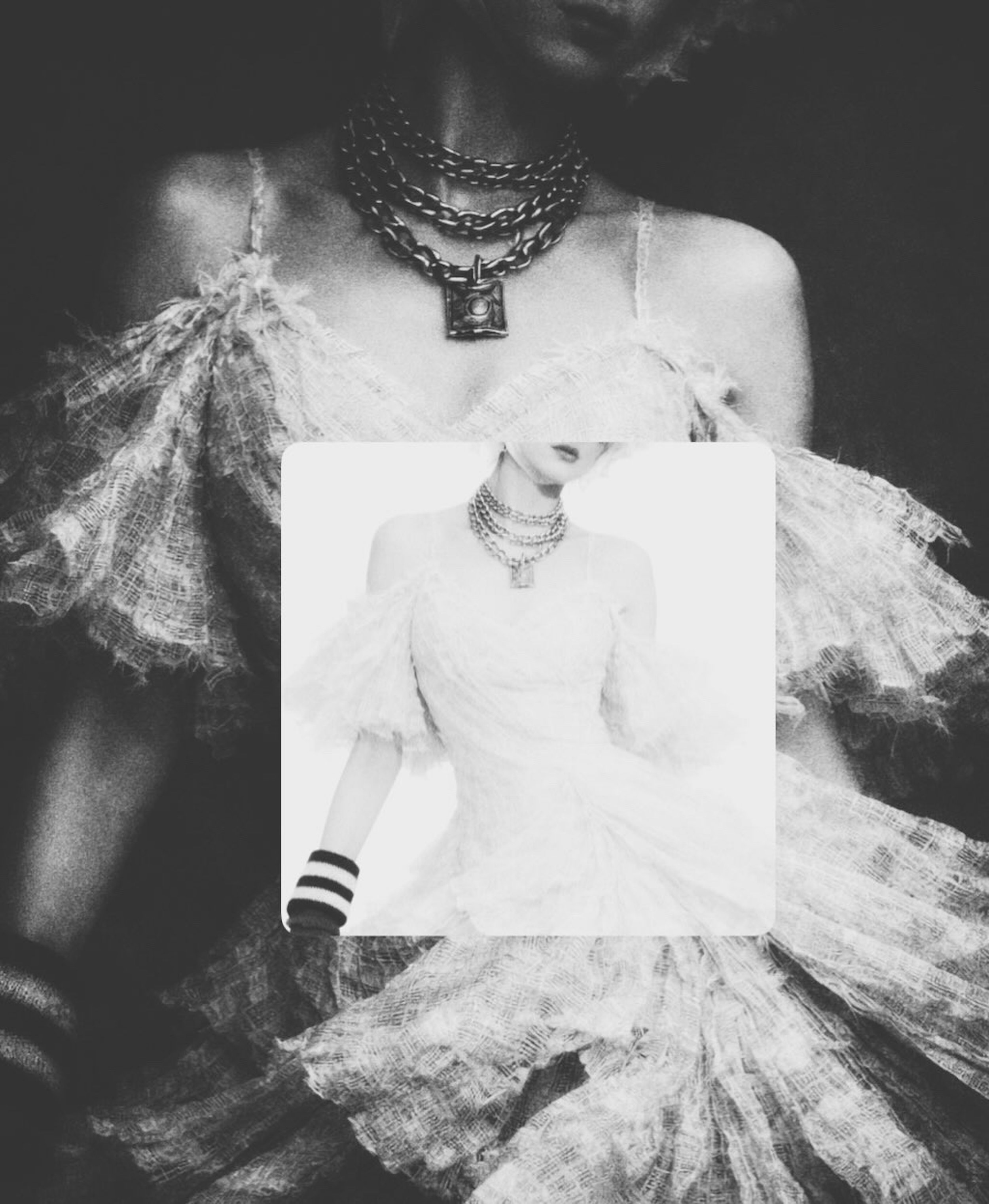
The result is a system that does not simply respond to consumer preference, but actively shapes it (© Edie Lou Freisinger)
Identity Within the System
Not all garments endure - some become fixed and recognizable like the trench coat, while others fade. The fashion system does not only produce trends; it determines which garments persist and which become stable references over time. The garment does not stay relevant on its own. A trench coat does not remain present because it is naturally timeless or independent of fashion. It remain present because the system keeps it there. Long before anything reaches the individual, a series of decisions - design, production, buying, distribution, and media - has already determined what enters circulation and what does not. What the fashion system ultimately controls is not only what is produced, but the range of possibilities within which selection takes place. Garments do not enter the world freely. They are shaped, filtered, and coordinated long before they become available to the individual. What appears in stores, on platforms, and in media is the result of continuous processes of forecasting, evaluation, and selection that determine which designs move forward. This means that the individual does not choose from an open field. The range of available garments is already structured. But what is available is not only a limited range of silhouettes and forms isolated, but a limited range of narratives. The individual does not encounter garments in isolation, but within pre-defined interpretive structures that shape how they are perceived and evaluated. Even the act of “choosing” carries with it an alignment. The system does not simply produce garments. It produces garments and their intelligibility - coordinating what is accessible. Through this feedback loop, the system coordinates demand and supply simultaneously, stabilizing certain products while continuously filtering out others. The result is a system that does not simply respond to consumer preference, but actively shapes it.
What appears as individual choice is embedded within a pre-structured environment in which the available options have already been defined. The individual participates in this system through acts of selection, but these acts take place within boundaries that are continuously produced and maintained. And what kind of role does garments play in our life and identity development? Well, a huge one. Each garment arrives with a set of associations - historical, cultural, and symbolic - that shape how it is perceived and how it can be read. To wear a garment is to position oneself within these associations, whether consciously or not. Garments function as one of the primary interfaces through which identity is expressed into the social world. They translate internal orientations - preferences, affiliations, positions - into visible signals that interpreted by others. And identity is established through consistency over time. A one-time choice does not create identity; it is the repetition similar choices that produces recognizable patterns. Garments enable this repetition because they are worn regularly and across different contexts. Through repeated use of similar forms, silhouettes, or codes, a pattern emerges that becomes legible as part of the identity. And obviously, identity does not develop in isolation, at it is not freely chosen as we think. What people wear each day may feel like a matter of personal taste, and in a way, it is, but these choices take place within a system that directs attention, shapes preference, and limits what is available.
At the same time, clothing is not only about expression, but about being understood. To dress is to communicate, and communication depends on shared codes. Individuals rely on recognizable forms - specific silhouettes, styles, and references - because they allow others to interpret what is being presented. A punk does not want to be mistaken for a banker, just as a banker does not want to appear as a punk. The intention is not only to express identity, but to ensure that this identity is read correctly. This need to avoid misunderstanding limits how far one can move outside established forms. If clothing becomes too unfamiliar, it risks becoming illegible. For this reason, even acts of difference or resistance remain tied to recognizable structures. They must still be understood within the system they appear to oppose. Garments therefore do more than reflect identity. They stabilise it by aligning personal expression with shared expectations. What is worn repeatedly becomes both a signal and a constraint: it communicates who someone is, while at the same time narrowing how they can appear without risking misinterpretation. In this sense, we can agree on that everyday choices are neither fully free nor entirely controlled. They take place within a structured environment that shapes what is available and how it can be understood, but they are not completely determined by it. People still develop preferences and form distinctive styles over time. This is the relation between structure and agency: identity is shaped by external systems, yet enacted through individual practice. The system does not eliminate personal style, but frames it. What is perceived as individuality emerges within a limited range of possibilities, and gains meaning through shared codes that make it understandable to others. The desire not to be misunderstood reinforces this alignment. Even when individuals differentiate themselves, they do so in ways that remain legible within the system. The result is not a loss of identity. Personal style does exists even if it doesn’t come from complete freedom. It forms within what is already there, but it becomes individual through the way it is worn, repeated, and made one’s own over time. Style does not have to be invented from nothing to feel real; it takes shape through small personal decisions, through what feels right without needing to be explained.
https://www.goodreads.com/book/show/24369658-key-concepts-for-the-fashion-industry
https://www.bloomsbury.com/uk/fashion-trends-9781350099012/
https://www.goodreads.com/book/show/464271.Fashion_ology
https://www.goodreads.com/book/show/765839.Fashion_and_Its_Social_Agendas
https://www.jstor.org/stable/4200841
https://moglen.law.columbia.edu/LCS/theoryleisureclass.pdf
https://www.mit.edu/~allanmc/bourdieu1.pdf
https://www.are.na/block/4114619
https://www.goodreads.com/book/show/23060.The_Fashion_System
https://www.sup.org/books/theory-and-philosophy/transparency-society
https://www.goodreads.com/book/show/381440.The_Society_of_the_Spectacle
https://web.stanford.edu/class/symbsys205/Diffusion%20of%20Innovations.htm
https://www.goodreads.com/book/show/2612.The_Tipping_Point
https://onlinelibrary.wiley.com/doi/pdf/10.1111/j.1533-8525.1969.tb01292.x
https://monoskop.org/images/1/19/Goffman_Erving_The_Presentation_of_Self_in_Everyday_Life.pdf
https://www.goodreads.com/book/show/256725.Human_Nature_and_the_Social_Order
https://www.goodreads.com/book/show/56013.Identity_and_the_Life_Cycle
https://www.goodreads.com/en/book/show/2043954.Human_Groups_and_Social_Categories
https://www.goodreads.com/en/book/show/199188.Culture_and_Consumption
https://www.erikclabaugh.com/wp-content/uploads/2014/08/181899847-Subculture.pdf
https://www.goodreads.com/book/show/37328.The_Consumer_Society