
forecast 2026: fashion IS not disappearing - it is being forced to grow up
As the fashion industry moves toward 2026, it is still operating in the long aftershock of rupture rather than the confidence of expansion. The industry is still shaped by the economic and psychological fallout of COVID - operating more cautiously than it did during the automatic-growth era of the 1990’s, 2000’s and 2010s. When COVID shut down travel, trade, and cash flow, fashion was forced to confront how dependent it had become on cheap money, smooth global logistics, and consumers who kept buying constant newness. Since then, fashion has been navigating overlapping pressures: rising costs, geopolitical instability, labor exposure, climate disruption, regulatory scrutiny, and a consumer who feels more cautions, more sceptical, and more fatigued than in the years of unrestrained growth.
Fashion’s problems didn’t begin in the last few years. Long before the recent global shocks, the industry was already operating on unstable ground: production pushed to the lowest-cost factories, wafer-thin margins, easy investor money, chronic overproduction, and a commercial culture built on constant novelty. This model was never built for durability. It was designed to maximize short-term volume: it prioritized rapid scale over resilience. This wasn’t a healthy system undone by bad luck. Large parts of the industry were already brittle. Many brands - especially in the mid-priced, weakly differentiated segment - operate with very little working capital - when revenue stops for even a short period, liquidity stress hits immediately. Those businesses were far less resilient than others. At the same time, the ultra-high-volume fast-fashion model had already stretched itself to the limit, relying on scale and speed that were never built for long-term stability. And at the top of the market, luxury - reshaped by conglomerates - increasignly borrowed from the same playbook: faster product cycles, aggressive growth targets, and brand management driven more by volume expansion than scarcity. The result overall is a huge disorientation - not just inside the industry, but among customers who are no longer sure what to trust, what to buy, or what anything is really worth. Prices keep increasing - but quality doesn’t always match, brands talk about sustainability - but claims feel vague or contradictory, trends move so fast that nothing feels stable, choice overload everywhere, the mid-market no longer feels like good value, and luxury feels mass.
Against that backdrop, the natural question becomes: what happens next? If the financial logic, supply systems, and cultural narratives that have sustained the industry for the past two decades continue to weaken, does the model simply continue until it breaks? And if that happens, what goes with it? Does fashion - at least in the form we currently recognize, with its brands, price signalling, trend cycles, and cultural authority - begin to disappear alongside the system that created it? Or does something else take its place, forcing the industry to evolve into a different shape entirely?

Against that backdrop, the natural question becomes: what happens next? (©Edie Lou)
Can Fashion Disappear - What History Tells Us
The short answer is - no. Fashion cannot die out. What can disappear are specific fashion systems: business models, industrial arrangements, or ways the industry is organised at a given moment in time. Fashion itself, understood as a social practice, has proven historically persistent. For fashion to disappear entirely, several fundamental things would have to stop at once. Humans would have to stop using dress to signal identity and belonging. Social differentiation would have to cease. And change in appearance over time would have to stop carrying meaning. History gives us no example of this ever happening, not even under extreme conditions.
What history shows instead is a constant pattern. Every time society goes through a major rupture, fashion compresses and adapts - and when they ease, it re-emerges in a new form. From early civilisations onward, humans have used dress to signal identity, status, belonging , and belief. Ancient cultures developed sophisticated systems of clothing, ornament, and symbolic distinction, embedding meaning deeply into how people appeared in public life. What emerges more clearly in late medieval Europe, however, is fashion in the strict sense: socially driven change in appearance, where shifts in dress become visible, meaningful, and expected over time. Being “current” or “outdated” became a concept and individuals choose whether to adopt or resist change. Dress was still strongly regulated by class, profession, gender, and law - sumptuary laws dictated who could wear what, but for the first time that regular, socially recognized stylistic change became a structural feature of society. Since that point, fashion has existed through dramatic transformations in political power, economic structure, religious authority, and technological organisation. Monarchies fell, empires collapsed, economies reorganized, and entire modes of production disappeared. Fashion systems were repeatedly dismantled and rebuilt, but the practice itself endured. This long history shows that fashion isn’t sustained by comfort or abundance. It is sustained by the human need to express identity through appearance - a need that does not disappear when conditions become unfamiliar or extreme.
That resilience becomes especially visible during moments of constraint. During the First and Second World Wars, fashion was tightly regulated by law: fabrics rationed, designs restricted, production standardized. Choice narrowed dramatically. Yet fashion did not vanish. It adapted. Governments across Europe and the United States introduced rationing systems, fabric quotas, and design regulations to conserve resources for the war. During the First World War, fashion was shaped by law in a fragmented but decisive way. Governments relied on emergency wartime powers, material requisition laws, and trade controls to limit fabric availability and prioritize military production, indirectly reducing ornamentation and excess and forcing fashion to adapt under conditions of legal scarcity. What began as indirect constant during the First World War became far more systematic and explicit during the Second, when governments moved from limiting materials to directly regulating civilian clothing production.
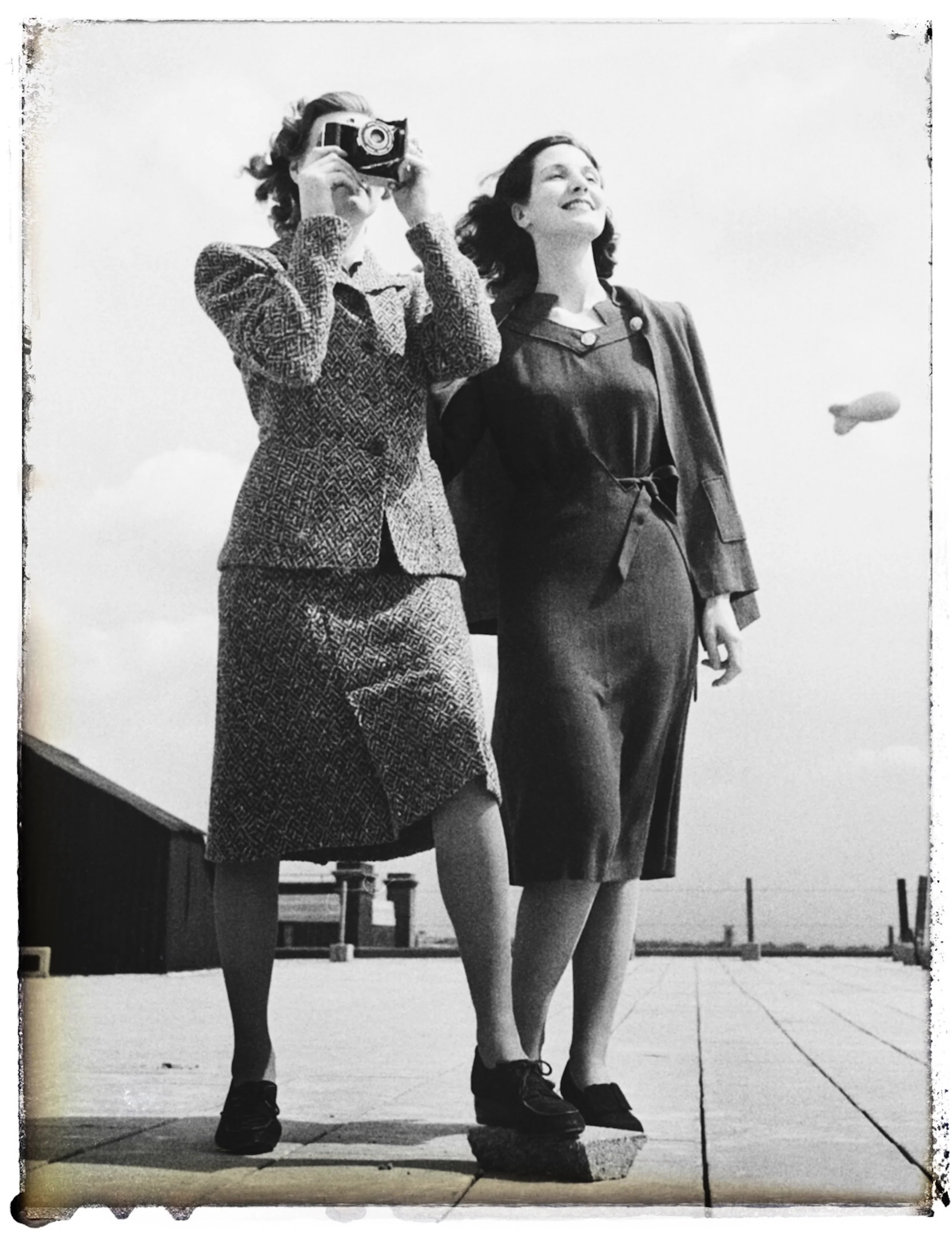
Standardised designs marked with the “CC41” (© IWM / public domain)
In Britain, clothing was subject to strict legal controls: limits on yardage, bans on pleats, cuffs, and excess buttons, and standardized “utility” garments approved by the state (Utility Clothing Scheme, 1941). It introduced standardised designs marked with the “CC41” - Civilian Clothing 1941 - label. In the United States, wartime fashion was shaped by binding production rules rather than aesthetic mandates. Beginning in 1942, the War Production Board restricted the use of wool, silk, leather, rubber, and metals, limited fabric yardage, and redirected textile production toward military needs, forcing designers and manufacturers to adjust silhouettes and details to comply with legal material limits. Similar restricitons existed elsewhere. These measures dramatically slowed production and narrowed choice, but they did not eliminate fashion. Expression shifted away from volume and ornamentation toward cut, fit, color, and how garments were worn, repaired, or repurposed. Fashion’s form changed, but its function - social meaning - remained intact.
When conditions are good, fashion expresses itself through volume and novelty; when conditions are harsh, it expresses itself through intensity, detail, and symbolic excess. When conditions collapse something counter-intuitive happens. People do not stop caring about how they look. Actually they care more. Why? Because in moments when the future feels unstable, social rules are shifting and identities are under threat, appearance becomes one of the few places where a person can still decide who they are. What the inter-war years show is crucial. In Berlin, for example, underground scenes, cabarets, queer culture, and avant-garde fashion became ways to invent new selves in a world that had lost its old rules. Dressing differently wasn’t just aesthetic - it was existential. People used clothing, makeup, hair, and gender play to declare who they were when traditional identities (nation, class, family, religion) no longer felt secure. Even when economies break, even when systems collapse, even when politics turns unstable, fashion doesn’t retreat - it becomes more charged.
Also, in unstable times, clothing becomes a form of social technology. A single well-kept coat, a carefully styled dress, or a neatly altered suit can determine whether someone is treated as respectable, desperate, employable, or simply ignored. When resources are scarce, appearances become high-stakes signals. People dress not just to express themselves, but to negotiate their position in a fragile social order. When someone turns whatever materials are available into a carefully constructed outfit in a moment of crisis, they are not dressing for beauty but for survival. The goal is to create an image of stability, wealth, or control when none exists, in order to secure access, safety, or resources in a collapsing world. Of course, in stable systems fashion functions very similar to this principle - but the consequences are smaller. You can afford to be playful, ironic, careless, or wasteful because our access to work, housing, safety, or social standing does not depend on a single outfit. When systems become unstable, those margins disappear. Appearance starts to carry real risk and real reward, and clothing becomes a tool for navigating uncertainty. In moments of instability, fashion becomes a weapon. It becomes a survival strategy - it becomes sharper, more intentional, and more charged, because what is at risk is one’s place in the world.
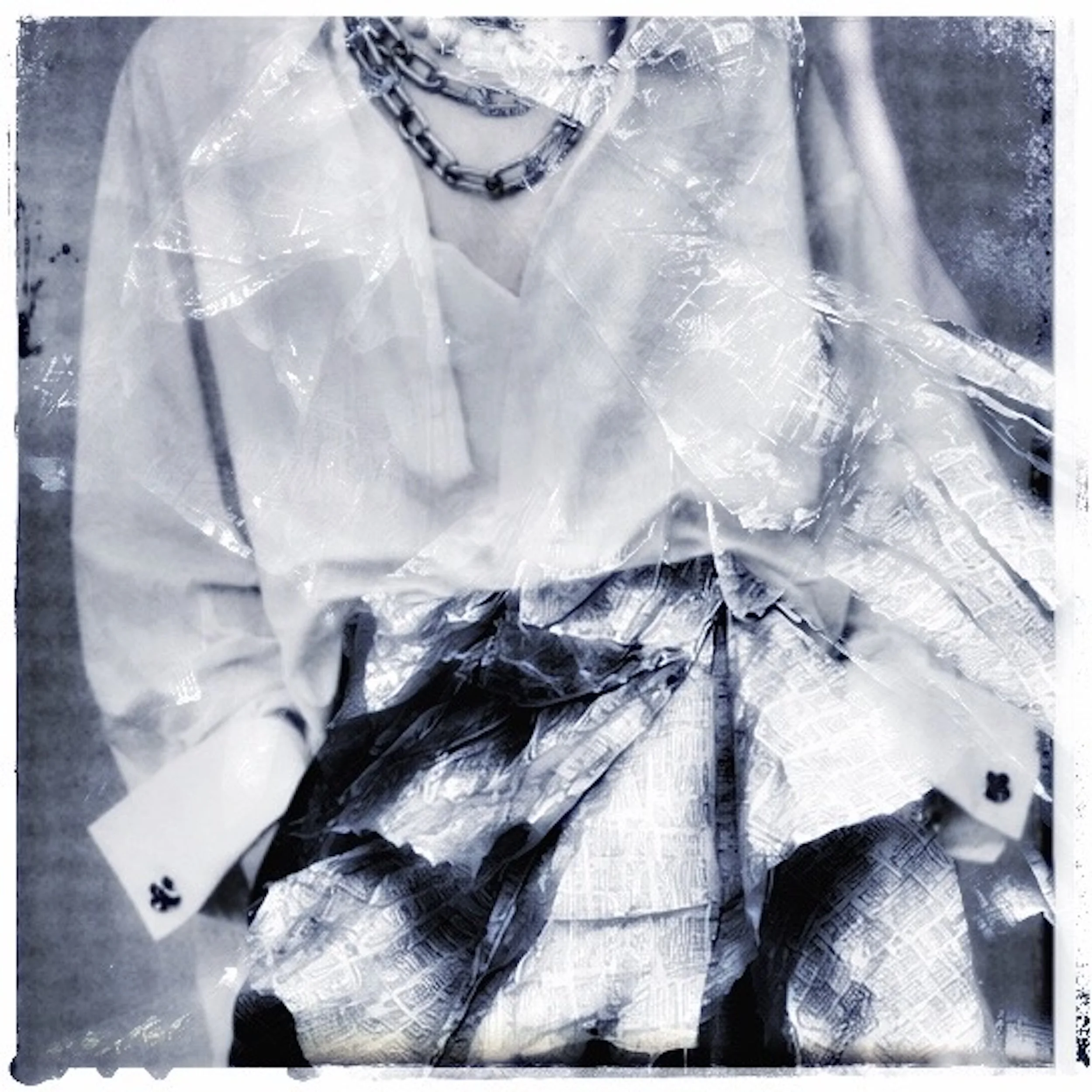
Fashion is not a fixed system but a dynamic process (© Edie Lou)
Fashion Doesn’t Vanish - But the Growth Model Probably Does
If history shows that fashion cannot disappear, it also makes something else clear: that fashion is not a fixed system but a dynamic process, repeatedly reorganized as social and economic conditions shift. Fashion itself is the human practice of using dress to express identity, belonging, difference, and meaning; the fashion system, on the other hand, are the economic, industrial, and organizational structures that produce and sell clothes at a given moment in history. History shows that the practice never goes away - but the systems that organize it regularly collapse and get replaced. So, what this history really shows is not just fashion’s resilience, but its adaptability. Fashion has always outlived the structures built around it. Courts disappeared. Guilds collapsed, Industrial models were replaced. Retail formats rose and fell. Yet the practice of using dress to express identity and status persisted. What changed was the machinery that delivered it.
Today, it is clear that both society and the fashion industry have reached a structural turning point - not in the demand for fashion as a cultural act, but in the economic and operational system that has governed it for the past several decades. The contemporary fashion economy was built on speed, volume, and constant expansion. It assumed cheap labor, frictionless logistics, abundant credit, and a consumer willing to absorb endless novelty. For long time, this structure appeared efficient. Large conglomerates consolidated brands, centralized sourcing, and built global distribution networks that allowed fashion to scale at unprecedented speed. Think about this: big groups like LVMH, Kering, Inditex, or H&M cumulated many separate fashion businesses and folded them into one corporate system. Instead of each brand making its own decisions about factories, materials, shipping, and retail, those functions were pooled and managed centrally. Isn’t that genious? That allowed companies to negotiate cheaper production, move goods faster across borders, and roll out the same product worldwide. This made growth possible on a scale that had never existed before. A single design could be produced in huge quantities, manufactured across multiple countries, shipped globally, and sold in hundreds or thousands of stores at once. In financial terms, the system looked highly optimized: high volumes, rapid turnover, and strong margins driven by brand power rather than value.
For long time, this structure appeared efficient. Brands expanded globally, collections multiplied - skyrocketed -, and marketing transformed novelty into a permanent state. But efficiency under ideal conditions is not the same as resilience. The system was built on cheap labor, cheap energy, open trade, and continuously expanding consumer demand - conditions that are no longer reliably in place. Environmental damage - from water depletion and chemical pollution to carbon emissions and textile waste - was treated as an externality, allowing garments to be priced and produced in ways that ignored their true ecological footprint. At the same time, labor was organized through fragmented global subcontracting systems that kept wages low, safety standards weak, and risk outsourced to the factories. A system that relies on hiding harm, pushing costs onto others, or keeping parts of the chain disposable is not resilient. It is temporarily efficient. It only works as long as no one pushes back. That is not stability - that is borrowed time. And in that environment, long supply chains, tight margins, and just-in-time production looked like smart optimization. But those same features make a system fragile when conditions change. A resilient system is one that can absorb shocks, operate with higher costs, and still function when parts of the chain fail. The dominant fashion model was never designed for that. So when those background conditions begin to shift - labor becoming more regulated, energy more expensive, trade more contested, consumers more cautious - the industry doesn't just slow down. It struggles, because the logic it was built on no longer matches the world it is operating in.

When profit starts to destroy value (© Edie Lou)
When Profit Starts to Destroy Value
One of the least acknowledged dynamics in the contemporary fashion industry is that financial success and additional revenue growth, beyond a certain point, begin to reduce the underlying symbolic capital that supports the brand’s pricing power. In most sectors, growth strengthens a product’s market position: higher volume lowers costs, increases efficiency, and reinforces competitive advantage. Please note: even when growth improves cost efficiency and market power, it does not mean the outcome is socially or ecologically good. Scale can coexist perfectly with overproduction, waste, and exploitation. Fashion operates differently because much of its value is symbolic. Status, distinction, cultural relevance, and perceived meaning do not scale in the same way as other physical goods. This creates a structural tension at the heart of the fashion economy.
Luxury and premium brands are pressured by investors and conglomerates to increase revenue. Once a brand is owned by a financial sponsor (or conglomerate) it is no longer primarily evaluated as a cultural entity. It is evaluated as a financial asset. That means it is measured on revenue growth, margin stability, EBITDA, market share, valuation multiples. To meet those targets, management is expected to produce continuous top-line growth. The most reliable ways to do that in fashion are to open more stores, expand into more markets, add categories (bags, shoes, fragrance, beauty, home, etc.), increase product drops, license the brand, push wholesale and outlets. Financial markets do not value companies based on what they are worth today. They value them based on what they are expected to become. A $2 billion fashion brand that is expected to stay at $2 billion is treated as a mature, low-growth asset. Investors assume its future cash flows are predictable but limited. That kind of company receives a lower valuation multiple, less media attention, and less strategic priority inside a group. A $2 billion brand that is expected to grow to $3 billion or $4 billion, even if it is less healthy, is valued higher because growth promises future profit expansion. That expectation is what drives share prices, executive bonuses, and acquisition strategies. So even when the brand is already profitable and culturally strong, standing still is financially punished. This is the mechanism that forces fashion into perpetual acceleration - and why symbolic dilution is not a creative failure, but a capital market outcome.
So, luxury and premium brands have to increase revenue through wider distribution, faster product cycles, and constant visibility. In the short term, this strategy works. Sales rise. Margins hold. Share prices improve. But as products become more ubiquitous and collections more repetitive, the symbolic scarcity that underpins fashion’s pricing power begins to dissolve. What once signaled value becomes meaningless. This process has been described in economic and sociological theory as symbolic dilution. Thinkers such as Thorsten Veblen and Pierre Bourdieu observed that status goods derive their value from differentiation and restricted access. When a brand becomes too widely available, it loses its ability to confer distinction, and with it the justification for premium or value-driven pricing. Profit growth, pursued beyond a certain threshold, begins to hollow out the very asset on which luxury brands depend. A luxury brand is not primarily an economic object. It is a brand of symbolic capital. People buy luxury goods or items because it signals that they belong to a certain social world or group - luxury consumtion is a form of social communication. Luxury goods function as symbolic shorthand in social space. They compress identity, aspiration, and belonging into something visible.
At the same time, luxury or premium brands draw on a second, equally important source of value: material and human quality. Premium and value pricing is not only justified by symbolic positioning, but also by the time, skill, fabric integrity, and labour embedded in each garment. Some customers are primarily motivated by status and recognition, others by durability, craftsmanship, and material value. As financial growth becomes the overriding objective, both are placed under pressure. Once a brand is under financial pressure to expand, it can no longer rely on its original, relatively small customer base. Even if those customers are deeply loyal and willing to pay for quality, they cannot absorb unlimited growth. Growth therefore requires expansion into much larger social segments. Expansion is driven through entry-price products, diffusion lines, outlets, and global retail. These make the brand financially reachable while preserving the image of luxury, drawing in a large aspirational customer base seeking cultural capital through consumption. From a financial perspective, this delivers growth. From a value perspective, it is corrosive. As the brand becomes socially common, it loses its power to confer distinction, and desire must be sustained through ever-higher marketing and visibility rather than real meaning.
At the same time, the pressures of scale and rising marketing spending flow into the product itself. As volume becomes the primary growth lever, brands are forced to rebalance their cost structure. Materials, labor, and production time are progressively optimized for scale rather than for quality. Fabric choices stop being guided by how well the materials perform over time and start being guided by how supply-chain efficiency can be optimized. Garment construction is reorganized around speed, predictability, and cost control rather than craft. Labor-intensive techniques such as canvassing, complex seaming, and hand-finishing are replaced by fused components, simplified patterns, and automated processes. The result is a product optimized for scale - a production logic indistinguishable from that of fast-fashion, even when applied to luxury-priced goods - driven by the same logic of volume, speed, and cost compression. And let’s face this: a brand doing $2 billion in annual revenue is already no longer a house of design - not to mention the brand that is expected to grow to $3 billion or $4 billion - it is an industrial system.
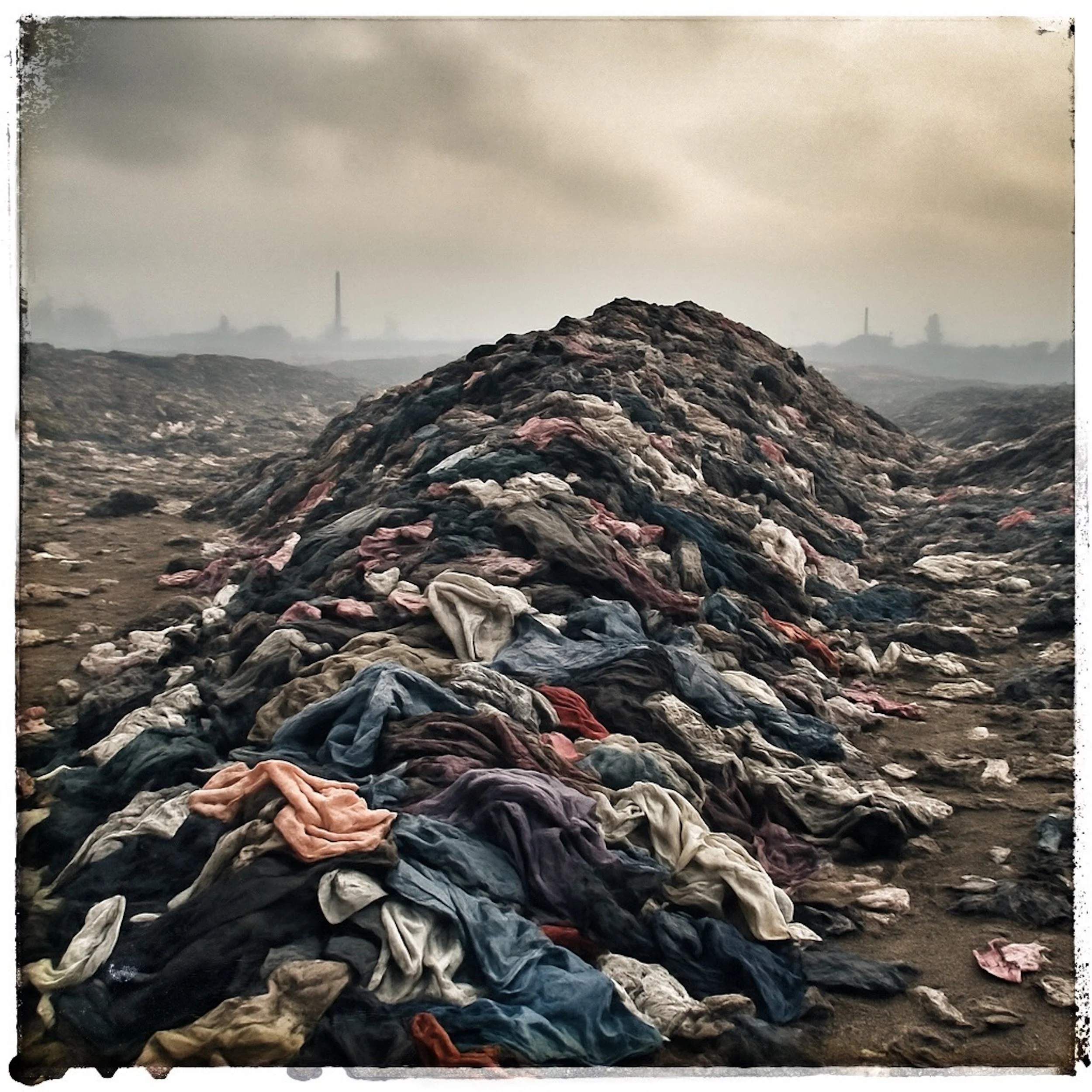
They are destroyed - burned, dumped in landfills, or shedded for low-grade recycling (© Edie Lou)
When Fashion Outgrows the Planet
But if we talk about the fashion industry, it is obviously not just luxury and premium brands - it is an industrial system spanning everything from ultra-cheap mass production to high-priced designer goods. The fashion industry as such is no longer constrained by demand. It is constrained by scale. As brands have grown into multi-billion-dollar operations, the volume of clothing they must produce to satisfy financial expectations has surpassed what any real market can absorb. There are not enough people who need, want, or can meaningfully use the quantities of garments required to sustain perpetual growth. But multi-billion-dollar fashion brands are still required to grow every year. That means they must sell more units every year - even though human wardrobes are already full. So production rises while real use does not. The industry is producing for financial targets, not for human life. The result is systemic overproduction since decades.
In this system, production is driven not by need but by revenue targets. Brands must fill factories, the brand must keep pushing enough product through its physical stores to make those locations financially viable - rents, wages, and inventory costs -, and meet investors‘ expectations, independent of whether the garments ultimately enter sustained consumer use. Unsold inventory is therefore not an exceptional outcome but a recurrent condition of growth-driven apparel production systems - it is a structural feature. So the system overproduces. While a mass-fashion brand produces more clothes than it sells - which is the normal state in the current system - it must remove the surplus from its main stores so it can keep selling new collections at full price. To do that, it uses three channels. First: discounting. The brand lowers the price in its own shops or websites - “sale”, “70% off”, “clearance”. This is meant to turn excess stock into cash, even if the margin is small or zero. Second: secondary markets. If the items still don’t sell, the brand sells them in bulk to other companies - outlet chains, off-price retailers, liquidation traders, export wholesalers. These buyers then resell the clothes cheaply in outlet malls or in other countries. This keeps the oversupply out of the brand’s main image. Third: disposal. If the clothes still cannot be sold, or if shipping and storing them costs more than they are worth, they are destroyed - burned, dumped in landfills, or shedded for low-grade recycling.
Luxury brands cannot dispose of unsold goods in the same way mass retailers do, because their business depends on maintaining high prices and an image of exclusivity. If a luxury brand were to sell large volumes of unsold stock cheaply, it would undermine both its pricing power and its symbolic positioning. Customers would stop believing that the product is rare or worth the price. When season ends, a luxury brand may have millions of dollars worth of unsold bags, coats, shoes, or accessories. If those items were discounted heavily or dumped into outlet channels, customers would see that the product is not truly scarce or worth full price. That would damage both brand image and future pricing. So instead of openly discounting excess inventory, luxury brands typically use other methods. They often store unsold inventory in long-term warehouses rather than release it onto the market. When a luxury brand “warehouses” unsold products, it means the items are kept out of public view and out of the retail market - sometimes for years, so that they do not appear discounted or overabundant and therefore do not damage the brand’s image. They write-off unsold inventory as a loss on their balance sheet. This allows it to accept the financial hit while keeping the physical goods hidden. But, obviously warehousing only works as long as there is space. As overproduction grows year after year, unsold inventory accumulates faster than it can be cleared. Warehouses fill up. Storage costs rise. Logistics become more complex. At some point, there is simply not enough physical capacity to keep the surplus. And, more than obvious, we cannot indefinitely store the output of a system that produces more than it sells.
Some of the goods are destroyed - incinerated, shredded, or otherwise disposed of - to prevent them from being sold cheaply or surplus is moved into private outlet networks, employee sales, or tightly managed resale channels where it does not visibly affect the main brand image. A growing amount of luxury surplus ends up in second-hand platforms and consignment markets, which absorb excess supply without touching official retail pricing. All of these are different ways of doing the same thing: protect the symbol by removing the product from visibility. But these mechanisms do not address the underlying surplus of production in either luxury or mass-market fashion; they merely displace it from the primary market. As a result, structural pressures continue to accumulate elsewhere in the system. This form of strategic displacement functions analogously to repression in psychological theory: the unresolved imbalance between production and demand is not eliminated, but redirected and deferred, allowing the system to maintain surface stability while internal pressures accumulate. In Freudian terms, this form of strategic displacement resembles repression: the structural imbalance between production and effective demand is pushed out of the system’s visible domain rather than resolved, allowing apparent stability to be maintained while latent pressures accumulate until they manifest as systemic breakdown - a process that is now becoming more visible than ever across the whole fashion industry.

creating new space for different forms of practice, value, and possibility (© Edie Lou)
Fashion, Grown Up
Fashion is not disappearing. What is disappearing is the illusion that it can expand indefinitely without consequence. The system that dominated the last decades - built on accelerating volume, compressed labor, symbolic dilution, and ecological overshoot - has reached the limits of its own viability. After this analysis, and by common knowledge more broadly, it becomes clear that although fashion will not disppear, obviously, the way it is currently structured cannot be sustained within the limits of natural resources, planetary boundaries, or human systems. What is reaching its end is not fashion as a cultural practice, but the expansionary economic logic that has governed it for decades - a logic that assumed infinite growth in a finite world.
The system has now entered a regime of saturation. In high-income markets, wardrobes function as stock rather than flow: people already own far more clothing than they can meaningfully use. Yet the industry remains organised around perpetual throughput, producing more units each season to satisfy revenue expectations. The result is chronic surplus, rising inventory risk, and an increasing reliance on discounting, secondary markets, and hidden write-offs to clear volumes that cannot be absorbed by real demand. This surplus is not a temporary imbalance but a structural feature of a growth model that has outpaced both human need and ecological capacity. At the same time, the physical and institutional constraints around fashion are tightening. Land, water, energy, carbon budgets, and waste systems impose hard biophysical limits on how much material throughput the industry can sustain. Regulation, traceability requirements, and labor standards are raising the cost of opacity and extraction, which is structurally necessary. Those forces are doing what markets alone failed to do: they are re-internalizing costs that were previously offloaded onto workers, ecosystems, and the future. Together, these forces are repricing risk across the system. Overproduction, once treated as a manageable inefficiency, now generates financial, legal, and reputational exposure. Models that depend on excess output to drive revenue become progressively less stable, while those that align production more closely with realized demand become more resilient.
Until now, fashion has rewarded speed and expansion. Historically, competitive advantage in the fashion industry was primarily associated with rapid retail expansion, high unit throughput, accelerated product cycles, and continuous revenue growth. This growth-oriented model was viable under conditions of low labor costs, high resource availability, limited environmental regulation, and the ability to externalize waste and social impacts beyond the firm’s balance sheet. That world no longer exists. First, fashion pushed to face its biophysical limits. It depends on land, water, fossil energy and waste systems. Water scarcity in textile-producing regions, rising energy costs, carbon budgets, and chemical discharge regulations directly affect production capacity and cost. Second, institutional and regulatory constraints raises fixed costs and increases liability for large, opaque, and fast-moving supply networks. And third, demand saturation.
So, what kind of fashion system will survive? Well, this is just a direction I can imagine. In the coming decade, the brands that survive will be those whose operations models remain viable under conditions of material, regulatory, and demand constraint. Large luxury groups, having converted symbolic capital into volume, now face a structural dilemma: at multi-billion-dollar scale, they function as industrial systems dependent on high throughput, global distribution, and continuous product turnover. Within finite resource limits and tightening regulatory regimes, this model is increasingly incompatible with the system. A small number of houses may choose to contract, limiting output and distribution in order to recover some degree of integrity. Most, however, will continue along a path of premium-priced industrial production, effectively converging with fast-fashion logic while preserving luxury branding. However, like all industrial production systems, they remain ultimately bounded by finite material and ecological limits. Nothing survives the exhaustion of resources.
The winners of the next phase of fashion will probably be those brands that are designed to be constant from the outset rather than brands that are forced to adapt later. New and emerging companies have the advantage of being able to build their models transparently and honestly from the beginning, in recognition of the current ecological, social, and economic conditions. Instead of inheriting systems optimized for unlimited growth they can take responsibility for their scale, their supply chains, and their impacts as they grow (not unlimited). And because they develop slowly and at smaller scale, they are able to build a real customer base. Value, in this context, is generated not only by the product itself but by the quality of the relationships that surround it - between the brand, its customers, and the workers and manufacturers included in the process. This relational structure creates feedback loops of responsibility and trust. Economically, this resembles a community-based system more than an extractive one - they rely on continuity, mutual dependence, and shared standards. Accountability is embedded in everyday operations rather than retrofitted through audits or campaigns. Over time, this coherence supports more stable demand, more predictable production, and a stronger alignment between financial performance and social and environmental responsibility. However, it is increasingly evident that structural change is not only necessary but unavoidable. The fashion industry has reached the limits of the model that sustained it for decades, and it must now confront those limits directly. This change is unavoidable: one chapter is closing and another door is opening - creating new space for different forms of practice, value, and possibility. A possibility towards a fashion industry that operates with great responsibility and transparency - one that behaves with the maturity of a grown-up system.
https://www.uvm.edu/~jfarley/EEseminar/readings/The%20Economics%20of%20the%20Steady%20State.pdf
https://www.kateraworth.com/doughnut/
https://timjackson.org.uk/ecological-economics/pwg/
https://www.files.ethz.ch/isn/125515/1366_keynestheoryofemployment.pdf
https://www.goodreads.com/book/show/134798.Capitalism_Socialism_and_Democracy
https://files.libcom.org/files/Caliban%20and%20the%20Witch.pdf
http://moglen.law.columbia.edu/LCS/theoryleisureclass.pdf
https://www.mit.edu/~allanmc/bourdieu1.pdf
https://www.hup.harvard.edu/books/9780674212770
https://monoskop.org/images/d/de/Baudrillard_Jean_The_consumer_society_myths_and_structures_1970.pdf
https://www.danathomas.com/deluxe.html
https://www.elizabethclinebooks.com/overdressed
https://faculty.fairfield.edu/winston/The%20Travels%20of%20a%20t-shirt.pdf
https://www.stockholmresilience.org/research/planetary-boundaries.html
https://www.nature.com/articles/461472a
https://www.science.org/doi/10.1126/sciadv.adh2458
https://www.ipcc.ch/report/ar6/syr/downloads/report/IPCC_AR6_SYR_FullVolume.pdf
https://www.ipcc.ch/report/ar6/wg3/chapter/chapter-11/
https://www.ellenmacarthurfoundation.org/a-new-textiles-economy
https://www.ellenmacarthurfoundation.org/fashion-and-the-circular-economy-deep-dive
https://www.jasonhickel.org/less-is-more
https://files.libcom.org/files/andrecc81-gorz-critique-of-economic-reason.compressed.pdf
https://www.sup.org/books/theory-and-philosophy/burnout-society
https://daily.jstor.org/virtual-roundtable-on-the-ego-and-the-id/