
knowledge exists - but does it travel? How access, familiarity, and receptivity shape the circulation of knowledge
Why should fashion need soil science - and why should soil science have anything to gain from fashion? Part of the answer lies in a very ordinary feature of human attention: unfamiliar subjects are easy to overlook. People are more likely to engage with ideas that connect to something they already recognize, value, or encounter in everyday life. Social and cognitive psychology have long shown that familiarity influences attention, processing, and willingness to engage. A subject that feels remote or abstract may therefore remain outside public awareness until it is encountered through a familiar context. The familiar subject provides the initial and entry point of attention; the new knowledge enters through that existing interest. Clothing, food, sport, architecture, or music can all become entry points into knowledge that people might never actively seek out on their own. So, first problem is that unfamiliar subjects may never attract attention in the first place.
The second problem is access to and circulation of knowledge - even when relevant knowledge exists, it is often spread across specialized research systems. The challenge concerns the integration and communication of knowledge itself. Research outcomes may continue to circulate primarily within academic and professional networks, where they are discussed among specialists but remain only weakly connected to other fields, to practical application, or to wider public understanding. As a result, knowledge can remain fragmented across disciplines and confined within expert communities, even when the research addresses questions of clear social, environmental, or material relevance. Important research outcomes may therefore exist without contributing to a broader shared understanding, informing practice, or reaching the people who could benefit from them. The central difficulty is therefore not whether relevant knowledge has been produced, but whether it is able to move across disciplinary boundaries, enter practice, and become accessible beyond the specialist communities in which it originated.
And not to mention that perceived personal relevance also shapes receptivity to knowledge. Research associated with health, culture, identity, safety, or immediate quality of life is more likely to attract attention. Medicine, dermatology, architecture, art, microbiology, or psychology can feel personally relevant very quickly: they promise better health, longer life, better environments, beauty, understanding of the self, or visible technological progress. Their relevance is easy to imagine and often easy to visualize. Soil science, for example, is different. Its importance is enormous, but soil is culturally and communicatively framed very narrowly. Public discussion often places it almost exclusively within agriculture, gardening, or specialist soil science, which makes its relevance to other areas of life much less visible. On the other hand, fashion design as cultural and psychological research is generally easier to make publicly engaging because the subject already sits close to identity, self-presentation, status, belonging, taste, consumption, body image, aspiration, and everyday behavior.
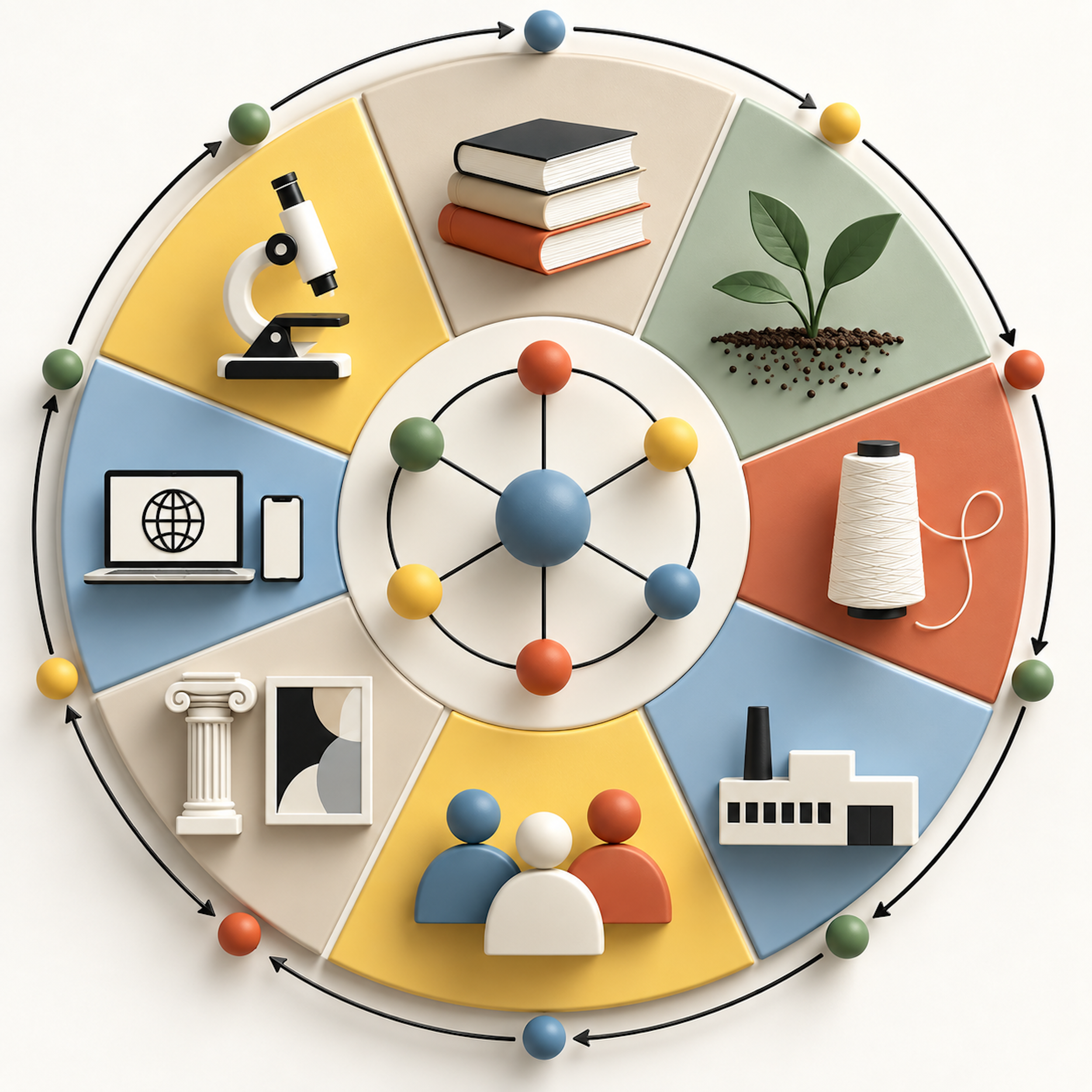
Model of Interdisciplinary Knowledge Circulation (@Edie Freisinger)
Why Some Fields Are Easier to Communicate Than Others
Some academic or research fields - for example medicine, psychology, architecture, economics, or fashion studies and research - are easier to communicate because their subject matter connects more readily to existing knowledge, personal experience, and perceived relevance. Cognitive psychology shows that new information is processed more efficiently when it can be attached to familiar schemas: existing mental structures through which people organize and interpret experience. Information that relates to self, everyday decisions, recognizable social situations, or already established interests therefore has an immediate cognitive advantage. It requires less effort to place within an existing framework, and this increased familiarity can improve attention, comprehension, and memory. Processing fluency is relevant here as well: information that is easier to process tends to feel more accessible and coherent, whereas unfamiliar terminology, abstract systems, or concepts without an obvious point of reference require greater cognitive effort before their significance can even be understood.
Perceived relevance further shapes whether people are willing to invest in that effort. Social and cognitive psychology have repeatedly shown that attention is selective rather than neutral. People are more likely to notice and elaborate information that appears connected to their goals or immediate concerns. By contrast, knowledge can remain psychologically distant when its consequences seem remote in time, space, personal experience, or conceptual familiarity. Construal Level Theory describes this tendency in terms of psychological distance: the farther a phenomenon feels from immediate experience, the more abstractly it tends to be represented. It was developed mainly by Yaacov Trope and Nira Liberman. The basic idea is that people represent things differently depending on how psychologically close or distant they feel. Psychological distance can be temporal (now vs. far in the future), spatial (here vs. far away), social (someone like me vs. a distant group), or hypothetical (certain vs. unlikely). So, when something feels psychologically close, people tend to think about it more concretely and in more detail. When it feels distant, they tend to represent it more abstractly, and harder to relate to, interpret, or engage with meaningfully.
And let’s face this: when people encounter knowledge that is unfamiliar, complex, or difficult to evaluate, they do not always respond with curiosity - obviously. Uncertainty can also produce psychological discomfort, and one way of reducing that discomfort is to lower the perceived value or importance of the unfamiliar subject itself. This can be understood through defensive devaluation: instead of maintaining the position “I do not yet understand this,” people may shift toward judgments such as “this is probably not very important",” “this is too irrelevant”. The response protects the self from the discomfort associated with uncertainty, lack of competence, or the inability to evaluate the information confidently. Ambiguity aversion may even occur earlier in the process. People generally prefer situations that are easier to understand, predict, and assess over those that are uncertain or difficult to interpret. The concept originates in decision theory, especially Daniel Ellsberg’s work on preferences under uncertainty: people often prefer options with known probabilities over options in which the probabilities themselves are unclear. In a broader psychological context, the same preference for the interpretable over the ambiguous helps explain why technically complex or conceptually unfamiliar information may be avoided. This avoidance does not necessarily involve a negative judgment of the subject; the person may simply prefer information that feels more familiar.
For science communication, this matters because unfamiliarity can therefore create a double barrier. A person may first struggle to understand a subject and then, precisely because of that difficulty, become less motivated to engage with it further. Research that is already distant from everyday experience can consequently become even more socially marginal if it is communicated only through specialist language or contexts that provide no familiar point of entry. This is why connecting unfamiliar knowledge to something already recognizable can be so effective: it does not replace the complexity of the subject, but it reduces the psychological distance required to approach it.

Contemporary Fashion Design and Soil Science do not usually meet in the same conversation (@Edie Freisinger)
Disciplinary Boundaries and Epistemic Hierarchies
Contemporary Fashion Design and soil science do not usually meet in the same conversation. Fashion design is an academic research discipline within art and design, with strong foundations in the human and cultural sciences and with empirical, qualitative, quantitative and practice-based research methods. Soil science belongs to the natural and agricultural sciences and investigates the biological, chemical, and physical processes that structure terrestrial systems. This separation is not unusual. It reflects a broader characteristic of contemporary higher-education systems: knowledge is organized in specialized disciplines that develop their own departments, publication cultures, funding structures, and professional networks. So, we can say that contemporary higher education is structured through disciplinary differentiation. Knowledge is institutionally organized into relatively autonomous fields with distinct epistemic traditions, validation regimes, professional communities, and research infrastructures. This differentiation enables high levels of specialization, but it also generates epistemic closure by directing researchers primarily toward the literature, methods, and evaluative standards of their own disciplines.
Specialization is essential to allow fields to develop considerable methodological and conceptual depth. The difficulty arises when the problems being investigated extend across several of these specialized domains. Obviously, advanced knowledge only develops when people are allowed to concentrate deeply on a limited field. A polymer chemist may specialize in molecular structure, polymerization, analytical chemistry, material behavior, and, e.g., FTIR spectroscopy to identify chemical bonds and functional groups. A linguist may focus on language structure, phonology, morphology, syntax, semantics, pragmatics, and discourse analysis, A soil scientist may specialize in soil chemistry, soil physics, soil taxonomy, plant-soil interactions, or soil ecology. A fashion researcher may work in cultural studies, sociology of consumption and identity, social-psychological research on group belonging, social norms and behavior, economics of markets, value chains, or textile research including the chemical behavior of fibers. And as researchers increase in depth within their own fields, they become progressively isolated within the boundaries of that expertise.
The consequences include the isolation and fragmentation of knowledge, missed connections between systems, reduced interdisciplinary exchange, limited accessibility of research beyond specialist communities and integration of complex problems across fields. What does that mean? It means that relevant research becomes less visible. It may simply fall outside the publication networks a researcher routinely follows. Work on fashion design, textiles, consumption, culture, or behavior may be published through sociology, social psychology, cultural studies, economics, design research, chemistry, material science, or engineering, while research on soil processes, microbial activity, degradation, or environmental interactions circulates through other specialist journals. Because these publication systems are only partly overlapping, relevant findings may never reach researchers working on adjacent aspects of the same problem. And even when researchers encounter work form another field, the terminology, assumptions, and methodological conventions may be unfamiliar. Different disciplines develop expertise through different combinations of experimental, quantitative, qualitative, interpretive, computational, and practice-based methods. Researchers may therefore be highly proficient within their own methodological traditions while being less familiar with approaches that are standard in other fields. Work from another field may therefore be misjudged not because it is incomprehensible, but because it is evaluated through standards designed for a different kind of inquiry.

Research can remain socially isolated even when it is publicly available in principle (@Edie Freisinger)
Access to Knowledge and the Limits of Availability
A further problem concerns the circulation of research beyond academia. Even when relevant knowledge has been produced, it may remain difficult for non-researchers to find, access, or interpret because it is distributed through specialist journals, databases, conferences, and disciplinary publication systems. Scientific and academic research is primarily written for other specialists. Papers are designed to meet disciplinary standards of precision, evidence, and peer preview, so they use technical terminology, established methodological conventions, and dense references to previous work. That is necessary for rigor, but it also means the text is often not written for a general audience. The publication system reinforces this. Research circulates through specialist journals, databases, conferences, professional associations, and institutional networks. Researchers know where to search because they are trained in those systems; non-researchers usually are not. Even before comprehension becomes an issue, there is a problem of discoverability. Access is another layer. While the share of open-access publications is increasing, many are still behind subscriptions and paywalls.
And even when access is free, accessibility is not guaranteed: a technically available paper may still be difficult to interpret without familiarity with the field’s terminology, methods, statistics, and assumptions. So, the issue has several stages: visibility, access, and interpretability. Research can remain socially isolated even when it is publicly available in principle. The knowledge exists, but the pathways through which it is produced and circulated are optimized for scholarly exchange, not necessarily for public understanding. And let’s face this, research can be strong within its own academic context and still be difficult to apply outside that context. Scientists are trained primarily to investigate, test, interpret, and publish; they are not necessarily trained to translate findings into design decisions, public communication, policy, education, or everyday material practice. At the same time, non-researchers may encounter scientific findings without the background needed to judge their relevance or credibility, especially when the research is highly technical, contradictory, or detached from familiar experience. So, the gap can be not only about access to knowledge alone. It is also about application and trust.
Put simply, knowledge can exist and still fail to circulate. As we said, specialization creates expertise, but it also tends to organize knowledge into separate academic systems. That produces horizontal separation across disciplines. At the same time, journals, databases, specialist language, paywalls, and academic conventions create vertical separation between research and the wider public. So, the real problem is not simply that knowledge is fragmented. It is that science and academic research can become structurally isolated from both neighboring fields and everyday understanding. And another layer in the picture is the difficulty of translating research into practice: findings may lack clear pathways for application, and non-specialists may struggle to judge their relevance or credibility.

In highly urbanized environments everyday life is mediated through concrete, supermarkets, packaged products, and global supply chains (@Edie Freisinger)
From Scientific Evidence to Cultural Meaning
The discussion so far has focused on a recurring problem: knowledge does not necessarily circulate simply because it exists, obviously. It can be slowed or blocked by unfamiliarity, psychological distance, disciplinary specialization, publication systems, limited accessibility, and the difficulty of translating research into practice. These barriers operate at different levels, but they produce a similar effect. Relevant knowledge can remain scattered across fields, confined within specialist communities, or too distant from everyday understanding to generate attention in the first place. The job, then, is not only to produce more knowledge. It is to create conditions in which existing knowledge can connect, circulate, and become intelligible across disciplinary and social boundaries without being flattened into a single language or method. The communication issues described above become especially relevant when research concerns systems that are materially connected, yet separated by unfamiliarity, disciplinary specialization, and limited pathways into public understanding and practice. The issue is also not simply “better science communication.” It is that knowledge moves more effectively when different forms of expertise and different publics are involved in producing, interpreting, and circulating it. Interdisciplinary work matters because complex problems rarely belong to one discipline alone. Different fields can contribute different methods, concepts, and forms of evidence. Community inclusion matters because people outside academia are not merely passive recipients of finished knowledge; they can contribute experience, observation, and practical context. Media and public-facing formats matter because they create routes through which research can reach people who would never enter the specialist channels where it was originally produced. Media, exhibitions, participatory formats, cultural platforms, and other accessible forms of communication can -and do- therefore function as interfaces through which unfamiliar knowledge becomes visible, interpretable, and socially relevant.
Soil science provides a particularly clear example of how knowledge about something materially essential can remain psychologically distant, culturally underrepresented, and institutionally specialized only. Soil is foundational to human existence, yet many people have little direct engagement with it. That disconnect is striking because soils underpin food production, water regulation, biodiversity, nutrient cycling, carbon storage, and the growth of plant-based materials. The Food and Agriculture Organization of the United Nations (FAO) notes that forming only a few centimeters of fertile soil can take centuries to around a thousand years, which means that soil degradation can exceed a human lifetime to recover. Although soil is foundational for human existence, it is largely invisible in everyday urban life and absent from everyday attention outside specialist, agricultural, and environmental contexts. People depend on soil without necessarily experiencing that dependence directly. Globally, the majority of people now live in urban areas. Around 58% of the world’s population is urban. This means that for most people, everyday contact with the systems that produce food, fibers, and goods is basically an abstract thing - or simply dirt. Soil is easy to overlook. In highly urbanized environments everyday life is mediated through concrete, supermarkets, packaged products, and global supply chains. In much of North America and Europe, food appears in highly polished and curated forms: at places like Whole Foods, Trader Joe’s, Carrefour, Monoprix, restaurants, specialty stores, and weekly markets.
The same applies to our garments. Just as food is usually encountered as a finished product, clothing reaches us as the end of a long material chain. By the time a garment appears in a store, showroom, or online, the soils, plants, animals, water, and agricultural processes involved in producing its fibers have largely disappeared from view. What remains visible is the finished object, while the ecological systems that made it possible are rarely part of the way we encounter or understand it. What we have here is a cognitive distance: the dependency is enormous, but the connection is rarely experienced directly. Soil remains abstract despite being materially fundamental - literally. Its processes are slow, often invisible, below ground, and distributed across systems that most people do not routinely observe. The field itself also has relatively low cultural visibility compared with medicine, psychology, architecture, fashion studies and research, or other areas that connect more immediately to health, everyday decision-making, and our cultural life. And nevertheless, soil science is also a comparatively young discipline in its contemporary institutional form, emerging later than many of the fields around which academic prestige was historically organized. As a result, it is less embedded in some of the symbolic structures through which scientific authority and visibility are culturally reproduced; the Nobel framework is a great example - it recognizes long-established categories such as physics, chemistry, literature, peace, medicine, and later, economics, but has no dedicated category for soil science. It is hard to think of any other fields where the gap between actual importance and perceived relevance is so large. And the paradox is very clear here: the more fundamental a system is to everyday life, the more invisible it can become when contemporary infrastructures separate people from its material origin.

Underpants Dress (@Edie Freisinger)
Toward a More Connected Knowledge Landscape
Soil science is highly relevant but culturally peripheral, often abstract to people outside specialist circles, and disconnected from many of the everyday contexts through which attention is normally captured. But if soil is fundamental to human existence yet remains largely outside everyday cultural consciousness, the central question becomes one of proximity: how can people be brought into closer contact with a subject they rarely encounter directly? As we discussed above, people are more likely to engage with subjects that connect to existing knowledge, familiar experiences, and perceived relevance. The question in our example of soil science is therefore how soil can enter those existing frames of reference rather than remaining confined to specialist discourse. So, how can soil enter everyday cultural consciousness at all? Citizen science already offers one answer by giving people a reason to look more closely. Proof by Underpants did this rather brilliantly: it took an ordinary, almost absurdly familiar object - a pair of new cotton underpants - and used it to reveal a process that normally happens invisibly beneath the ground. They used the buried cotton underwear as a bioindicator to assess soil biological activity and compare soil health across different land-use types. Soil biological activity is normally invisible and difficult for non-specialists to assess. The project made it tangible through the garment: participants buried the underwear, recovered it after a defined period, and sent it in for scientific analysis of the soil and the degree of textile decomposition. This gave participation a concrete benefit, particularly for farmers, because the process returned information about the condition and biological activity of their own soil. At the same time, the project stepped beyond conventional research communication by combining citizen science, direct participation, and an everyday object with formal scientific analysis.
So, the project itself was already an unusually effective form of public-facing research because it translated highly specialized soil research into a form that non-specialists could immediately understand and engage with. Instead of communicating soil biological activity only through technical measurements, publications, or laboratory terminology, it made the research visible through the decomposition of a familiar everyday object. This turned otherwise abstract scientific knowledge into something concrete, legible, and publicly accessible without removing its scientific basis. Proof by Underpants successfully translated specialist soil research into an accessible and memorable format, but its audience still remained largely within or adjacent to the existing soil-interest ecosystem: farmers, agricultural communities, environmentally engaged participants, private gardeners, and people already receptive to soil-related questions. The communication barrier was reduced, but the cultural boundary was not fully crossed. So, the issue here is no longer only: How do we make soil science understandable? It is: How do we bring soil knowledge into cultural spaces where soil would normally not appear at all? How to bring the majority of the population closer to something so essential to their lives, yet so absent from their everyday attention? How to build the bridge?
So, what talks to city people? The urban culture itself. For many urban residents, the day is structured around a sequence of cultural and commercial environments. They leave their apartment, move through busy streets, transit systems, cafes, workplaces, universities, shops, gyms, restaurants, galleries, museums, cinemas, theatres, bars, parks, markets, and public events. In between, they are constantly exposed to phones, social media, advertising, editorial media, visual merchandizing, architecture, signage, music, food culture, and fashion. ‘Their attention is shaped by these repeated encounters. So, if we want soil to become culturally visible to urban populations, it has to enter that daily circuit. Not as a specialist lecture hidden somewhere on the edge of town, but through the places and formats people already pass through: art exhibitions, magazines, shops, cultural venues, design, food, clothing, etc. And for an urban audience, art and exhibition spaces are particularly effective because they are already part of the cultural environments in which people seek stimulation and new ideas. Bringing soil into these spaces allows an otherwise culturally peripheral subject to enter public attention through a context in which curiosity is already expected.

Soil Bodies Logo (@Edie Freisinger)
The Underpants Dress was developed in exactly this space. Created for the Pilzfestspiele in Vienna in 2025 and exhibited at OstLicht gallery, it transformed material originating from Proof by Underpants into an object that could carry soil research into an artistic and cultural environment. The Rococo dress was chosen deliberately as a communication tool. Soil is culturally in the background - a Rococo dress does the opposite. It is excessive, theatrical, historically coded, and highly visible. By transforming underwear from Proof by Underpants - material that would otherwise have been discarded - into a spectacular historical silhouette, the project created a visual contradiction: material associated with decomposition, dirt, agriculture was turned into an artistic object with a strong cultural presence. That contrast gives the object communicative force because it created incongruity. The underpants alone are evidence from a soil experiment, but the Rococo silhouette transform them into something that demands attention. It creates surprise because two categories that people do not normally connect are suddenly forced together: soil science and high fashion, agriculture and cultural display. And the communication to an urban audience worked because the dress moved soil into a cultural setting where people were already receptive to visual and artistic stimuli. It created salience. Human attention is especially responsive to novelty, contrast, and incongruity. The object interrupts routine perception and makes people look. It used a familiar cultural form - even if someone knows nothing about soil science, they understand what a dress is and can immediately recognize the historical context of Rococo, giving the brain an existing schema to work with - and it created curiosity through incongruity. The mismatch of the categories that do not normally belong together produces questions: why is this object made like this? Curiosity then becomes the bridge to the scientific explanation. It opens a communication door that would usually stay firmly shut.
And guess what: the dress did not only work as a way of carrying soil science into urban culture - it worked also to introduce fashion and textile-system questions to audiences more familiar with soil and agriculture. The mechanism remained the same: unfamiliar knowledge arrived through something familiar. When the dress was later exhibited at the Bio-Ackerbautage in St. Katharinental, farmers, soil scientists, agricultural scientists, and other professionals approached it from a soil and agricultural perspective, and the garment opened a route into questions of textile production, fiber crops, cotton monocultures, overconsumption, and the scale of the fashion industry – something that people usually extremely underestimate. It also made a connection visible that is often fragmented across sectors: many garments begin with agriculture and soil, move through industrial textile and fashion systems, and eventually return to questions of waste, decomposition, and end-of-life. The encounter revealed an unexpected knowledge gap, btw. Even within an audience closely connected to agriculture and soil, the relationship between farming, fashion, and the full material life cycle of a garment - including the environmental impacts and their consequences for soil health was not necessarily immediately recognized. So, the dress functioned not simply as a vehicle for bringing soil science into urban culture, but as a concrete point of connection through which different audiences could recognize relationships that are usually considered separately.
So, Proof by Underpants used a familiar textile object that could make soil activity understandable. The Underpants Dress showed that the same material could then cross into cultural spaces and connect audiences who normally operate in different worlds. And, because Proof by Underpants and the Underpants Dress proved so effective in making soil visible, understandable, and culturally legible, developing a project that carried this communication further into the urban population while also making the environmental and soil health impacts of the textile industry visible, became an almost inevitable next step. Soil Bodies - The Living Tapestry is a new interdisciplinary participatory project that grew from the question opened by Proof by Underpants and the Underpants Dress, taking some of the communication lessons forward into a new context - bringing soil health, textile systems, art, fashion studies and public participation together in a broader urban-facing framework. It uses garments to connect soil science with fiber origins, textile production, consumption, decomposition, and material afterlife. Through direct engagement with garments and soil, the project creates a participatory framework for making these relationships visible and circulating them beyond the soil-interested public. It expands both the audience and the question while continuing to communicate soil health itself. Soil health remains central, but it is placed within a larger material and cultural system that connects scientific, environmental, and everyday knowledge, while deliberately entering cultural hubs of urban life. But this is another story - one for the next article, where Soil Bodies - The Living Tapestry can take the center stage. The project stands on its own, it is a distinct project with its own research questions, methods, and objectives, but it also knows where it came from: it acknowledges Proof by Underpants as an important point of departure, and without that experiment, this one would probably not exist at all.
https://www.goodreads.com/en/book/show/1835409.A_Theory_of_Cognitive_Dissonance
https://www.goodreads.com/en/book/show/1081221.Attention_and_effort
https://www.goodreads.com/en/book/show/8016563-the-psychology-of-curiosity
https://psycnet.apa.org/doiLanding?doi=10.1037%2F0022-3514.37.10.1915
https://pubmed.ncbi.nlm.nih.gov/15582859/
https://cdn.isr.umich.edu/pubFiles/historicPublications/Theattitudinaleffects_2360_.PDF
https://archive.org/details/academictribeste0000bech
https://www.hup.harvard.edu/books/9780674258945
https://wsupress.wayne.edu/9780814320884/
https://www.nationalacademies.org/read/11153/chapter/18
https://lawcat.berkeley.edu/record/365225?ln=en
https://mitpress.mit.edu/9780262300988/open-access/
https://uclpress.co.uk/book/citizen-science/
https://openknowledge.fao.org/handle/20.500.14283/cb1929en
https://nph.onlinelibrary.wiley.com/doi/10.1002/ppp3.70259
https://population.un.org/wup/
https://www.diplomacy.edu/actor/united-nations-department-of-economic-and-social-affairs/