
soil bodies
the living tapestry
Burry a garment. Unearth it. Bring it into the project. Together, we turn what the soil leaves behind into one collective tapestry.
-
Register, bury one garment in your soil, leave it there for the defined period, then excavate it and bring it into one collective tapestry.
Wherever possible, we will work on the Soil Tapestry together. If geography makes that impossible, we will find another way for you to contribute.
The entire process is guided step by step. Scroll down for the full project journey. After registration, you will receive a welcome email, and every following step - from burial to excavation, documentation, and return - will be communicated clearly as the project progresses.
REGISTER HERE
Through conceptual fashion as contemporary art, and citizen participation, Soil Bodies shall make the common ground we all share visible - soil. The Soil Tapestry symbolizes interconnectedness, inclusivity, shared responsibility, and the enduring aspiration for world peace.
Soil Bodies - The Living Tapestry is a project by Edie Lou Studio (ELS), conceived and led by Edie Freisinger, and developed in scientific collaboration with Dr. Sebastian Franz Bender (Agroscope).
Soil Bodies is part of SOILSCAPE - Spreading Open and Inclusive Literacy and Soil Culture through Artistic Practices and Education, a project funded by the European Union’s Horizon Europe Research and Innovation Programme under the EU Mission A Soil Deal for Europe, and co-funded in Switzerland by the State Secretariat for Education, Research, and Innovation (SERI).


Upcoming event
Soil Tapestry Making & Sunday Brunch
25 April 2027 - at Maison Shift, Zürich
Come for brunch, stay for the stitching. A day of connecting people, stories, and soil-worn textiles - bringing classic embroidery and hand-stitching skills into a contemporary context while the Soil Tapestry takes shape.
Soil Bodies
The Living Tapestry
What do your clothes have to do with the ground beneath your feet?
More than you think.
Soil keeps us alive, but most of us barely think about it. Clothes are hardly optional either - most humans are not wandering around naked - and almost everything we wear starts with soil and eventually ends up back in. We need water, food, and clothes to survive - this is not a question of taste, style, or being “into fashion” - soil health and textile literacy are not niche subjects; they are part of understanding the basic systems our lives depend on.
Soil Bodies uses conceptual fashion as a form of communication - making the ground beneath us visible, raising awareness of soil health while asking us to look more closely at what we wear, where it comes from, and where it goes.
Be part of Soil Bodies. Bury a textile. Follow its journey. Add your piece to the tapestry.
For German, French, and Italian versions of the project, please visit www.soilproof.org
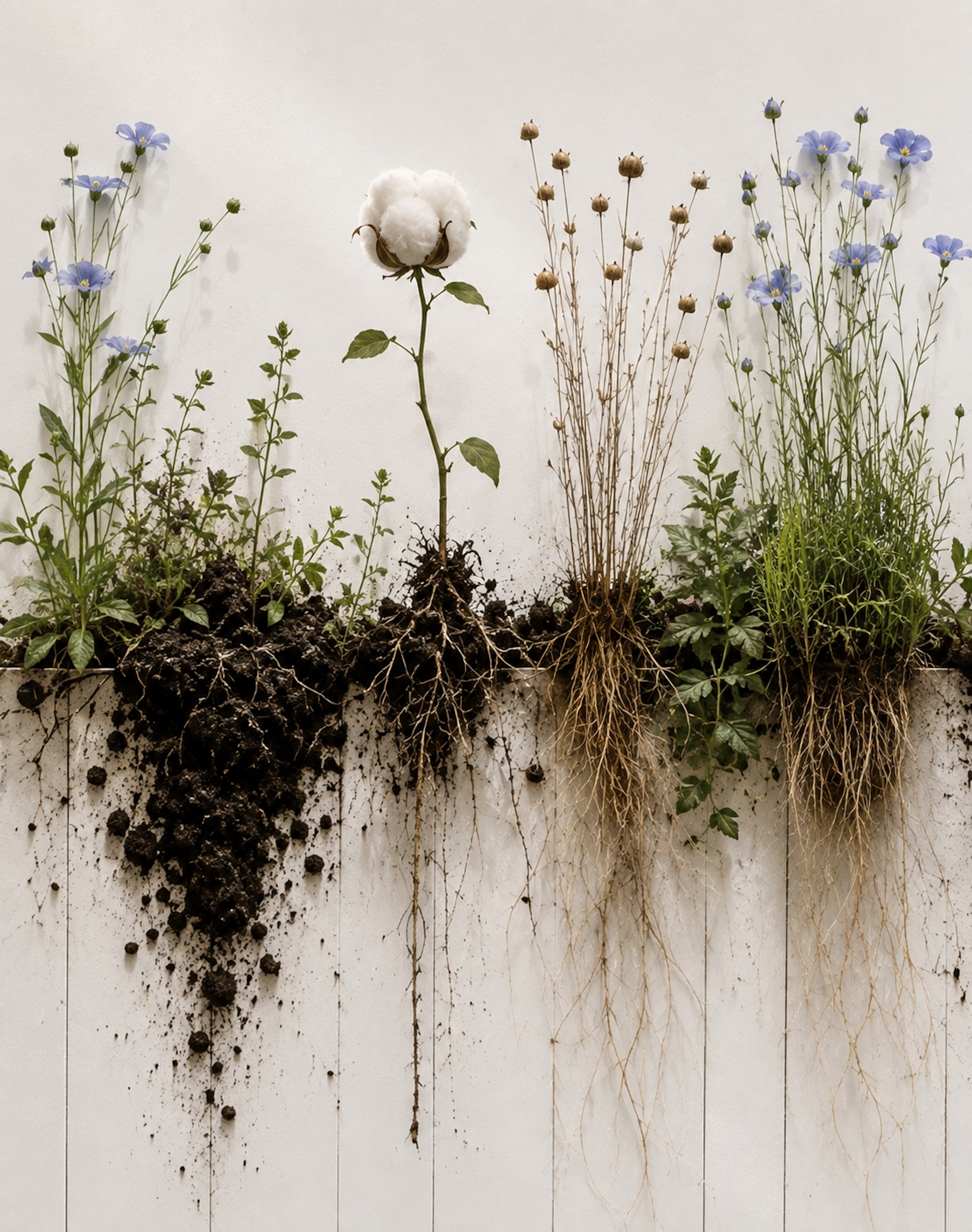
Soil Bodies - is a SOILSCAPE project by Edie Lou Studio (ELS), developed in collaboration with Agroscope and FiBL.
Combining citizen science, conceptual fashion, and soil science, the project investigates the relationship between textile materials and living soil.
-
What is Soil Bodies?
Soil Bodies is a project developed and led by Edie Lou Studio in collaboration with Dr. Sebastian Franz Bender (Agroscope) and FiBL (Research Institute of Organic Agriculture). The project is part of the SOILSCAPE -Spreading Open and Inclusive Literacy and Soil Culture through Artistic Practices and Education - project, funded by the European Union’s Horizon Europe Research and Innovation Programme under the EU Mission “A Soil Deal for Europe”. In Switzerland, the programme is co-founded by the State Secretariat for Education, Research and Innovation (SERI). The project, Soil Bodies runs from April 2026 to August 2027.
Soil Bodies explores the relationship between soil health and textile materials through an interdisciplinary framework that brings together soil science, education, citizen participation, and the expertise of professionals from the fashion and textile industry. Through the collective act of burying garments and textile samples, participants contribute to the creation of the Soil Tapestry and a small Soil Bodies capsule collection, both developed throughout the project.
Conceptual fashion as contemporary art serve as the project’s primary communication tool, translating scientifically grounded knowledge on soil health into accessible public experience. Fashion provides a particularly relevant communication medium, as textiles represent one of the most direct interfaces between people, natural resources, and everyday life creating new ways for the public to engage with the relationship between soil, material lifecycles, and they impact on soil health.
The project combines citizen science, conceptual fashion as contemporary art, educational practice, and soil science to encourage dialogue around soil, textiles, and their environmental impacts within the context of the Planetary Boundaries framework developed by the Stockholm Resilience Centre. Soil Bodies creates an interdisciplinary platform for dialogue, knowledge exchange, and public participation. The project will culminate in the public exhibition of the Soil Tapestry and the capsule collection in 2027.
Soil Tapestry - is created from the garments and textile samples that participants have buried in different soil ecosystems throughout the project.
Each contribution represents a unique interaction between a textile material and its local soil environment.
-
What is Soil Tapestry?
The Soil Tapestry is the project’s principal outcome, alongside the Soil Bodies capsule collection, which will be created from selected elements of the tapestry. Both outcomes will form the basis of a series of public exhibitions, beginning with the first in August 2027. As each garment is buried in a different soil environment under unique ecological conditions, every contribution undergoes its own material transformation. Differences in soil composition, biodiversity, climate, moisture, land use, and textile composition result in distinct visual and material outcomes, making every piece of the tapestry scientifically and artistically unique - reflecting both the diversity of humanity and the shared ground upon which we all stand.
By brining these individual contributions together into a single textile artwork, the Soil Tapestry reflects both diversity and interconnectedness. It symbolizes the shared ecological systems that connect people across geographical and cultural boundaries, while highlighting the relationship between textiles and soil throughout their lifecycle - from the natural or geological resources from which materials originate to their interaction with the environment at the end of their use. The tapestry represents a collective reflection on our shared responsibility for the natural ecosystems that sustain life.
Participant Portfolio - is a curated collection of documents that records the individual contribution of Soil Bodies and The Living Tapestry.
It includes your Personal Soil Report, Material ID, Exhibition Invitations, and Participant Certificate.
-
Personal Soil Report
Prepared by Br. Sebastian Franz Bender (Agroscope), the Personal Soil Report provides an expert interpretation of the biological activity of the soil based on the condition of the returned garment and the documented burial environment. Taking into account the burial location, land use, and the garment’s material composition, the report offers an informed assessment of the biological processes that may have occurred during burial - including the activity of soil microorganisms and fungi. While it is not a laboratory soil analysis, it provides a scientifically informed interpretation of soil health based on the observed material transformation.
Material ID
Developed by ELS, the Material ID provides an expert analysis of your garment from a fashion and textile perspective. It identifies the material group (e.g. cellulose-based, protein-based, synthetic polymer-based, or lab-grown fibres), documents the fibre composition and manufacturing pathways, and explains the material’s behavior in soil and the end of its life. The Material ID also provides estimated information on resource use and environmental impacts associated with the production of the garment’s fibers, including land use, water consumption, greenhouse gas emissions, and their relationship to planetary boundaries. The Material ID is an educational document. It does not constitute an official certification or laboratory analysis.
Exhibition Invitations
Participants will receive invitations to the project’s exhibitions and public programme, including exhibition openings, artist talks, scientific presentations, and special project event. These gatherings provide opportunities to experience the evolving outcomes of Soil Bodies - The Living Tapestry and engage directly with the artistic, scientific, and educational dimensions of the project.
Participant Certificate
Each participant will receive an official certificate recognizing their participation in Soil Bodies - The Living Tapestry. Participants will also be acknowledged in the project’s exhibitions and related publications unless they choose to remain anonymous.
°1
CITIZEN SCIENCE
Conceptual fashion as contemporary art becomes communication tool for soil health and the environmental challenges of the textile industry.
°2
CONCEPTUAL FASHION
Public participation brings together citizens, soil scientists, and professionals from the fashion and textile industry.
°3
SOIL SCIENCE
Developed in collaboration with soil scientists and professionals from the fashion and textile industry, the project shares knowledge on soil health, textile materials, and their interconnected role in sustainable practices.
Healthy soil is one of the world’s most valuable living resources.


step 1: register
Register online to participate in the project
-
Complete the online registration form to join Soil Bodies. Registration is available via the QR code above. Once the registration period has closed, participants will receive a project package by post containing detailed instructions and prepaid return shipping label for returning the garment to ELS after the burial period.
For participants residing outside Switzerland, shipping and return arrangements will be discussed on a case-by-case basis to identify the most suitable transport solution.
step 2: Bury textiles
Bury textile samples and watch soil transform
-
Step 1: Select a garment
Choose one CLEAN, preferably white or black garment from your wardrobe that you no longer need. (White is the best to see the natural colors created by soil)
Examples include:
T-shirts
Shirts
Dresses
Trousers
Sweaters
Undergarments
Step 2: Identify the Textile
Before burying the garment, please record:
Garment type
Textile or fiber composition
Color
Location of burial and land use type (e.g. private garden, mosaic farming, permaculture, vineyard, agricultural monoculture, meadow, lawn, woodland etc.)
Please note the textile composition as accurately as possible from the care label. Examples include:
Cotton
Linen
Wool
Silk
Viscose
Polyester
Nylon
Tencil
Acrylic
Blended fibers (fiber composition (%) if available)
Understanding how different textile fibers interact with living soil is a central part of the project
Step 3: Bury the garment in the soil of your choice. Leave it in the soil for one month.
Carefully cut the vegetation and topsoil into square sections and lift them gently to preserve the existing soil structure. Dig a shallow pit approximately 10-15 cm (4-6 inches) deep and place the garment flat at the bottom, ensuring maximum contact between the textile and the surrounding soil. Cover the garment completely with the excavated soil before carefully replacing the square sections of vegetation in their original position. Leave the burial site as undisturbed as possible and mark the burial site so that the garment can be located easily after the burial period.
step 3: recover and return
Send the excavated garment back using the prepaid return label and packaging provided
-
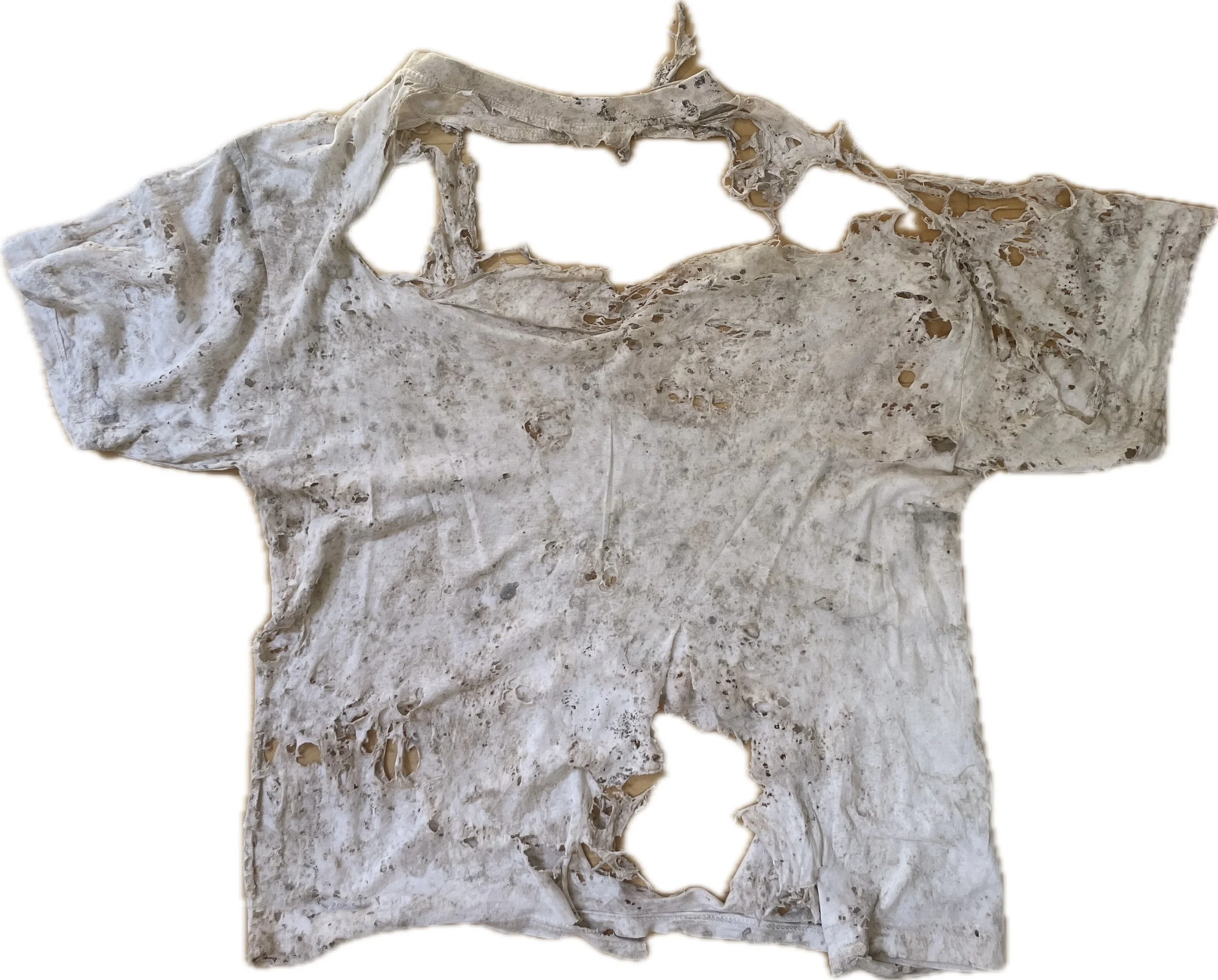
After approximately one month, carefully excavate the garment from the soil, taking care not to damage the material. If preferred, gloves may be worn during excavation. Allow the garment to air dry naturally if it is damp, but please do not wash, clean, or otherwise alter it. Traces of soil, microorganism, fungi, roots, and the material transformations that have occurred during burial are an important part of both the scientific documentation and the artistic process. Once dry, place the garment in the original return packaging provided and send it back using the prepaid return shipping label. The returned garments will be documented by the project team and become part of the next stages of Soil Bodies - The Living Tapestry.
step 4: contribute to the soil tapestry
Returned garments become part of the collective Soil Tapestry and the Soil Bodies capsule collection, with the first collective tapestry-making session taking place on 25 April 2027 at Maison Shift in Zurich.
-
Soil Bodies participants are invited to join the first collective assembly of the Soil Tapestry on 25 April 2027 at Maison Shift in Zurich. The gathering will begin with a shared brunch, followed by the collective making process, where participants can work together, exchange skills, experiences and perspectives, and contribute directly to the construction of the tapestry.
The recovered garments will be attached to a continuous base fabric and gradually assembled into the Soil Tapestry. Guided by designers, participants can work with a range of techniques, including hand sewing, embroidery, mending, safety-pin construction and other forms of textile assembly. No specific level of sewing experience is required.
The gathering is conceived as an intergenerational and participatory learning environment. Its pedagogical structure is informed by John Dewey’s understanding of education as a process grounded in experience, shared activity, and social interaction. Knowledge is therefore not positioned as something transferred in one direction from expert to participant, but as something that develops through collective practice, observation, discussion and participation.
This particularly relevant to textile knowledge, much of which is tacit and embodied. Skills such as embroidery, repair, hand sewing or material handling are often learned through demonstration, repetition, and working alongside others rather than through written instruction alone. The gathering therefore creates a context in which established techniques can be rediscovered, transmitted and adapted, while newer approaches and perspectives can enter the process at the same time.
The intergenerational dimension is deliberately reciprocal. Older participants may contribute techniques, experiences, and forms of craft knowledge that are becoming less visible in everyday life, while younger participants may introduce different methods, references and cultural perspectives. The aim is not to preserve one fixed tradition, but to create a setting in which knowledge can circulate across generations.
At the same time, the shared table functions as a social space for discussion. While working on the tapestry, participants can exchange perspectives on soil, clothing, textile materials, production, care, repair, and the wider relationship between fashion and the environment. Soil remains a central point of reference throughout the gathering, linking the material transformation of the garments to the social process through which they are subsequently assembled.
The Soil Tapestry therefore develops through two interconnected processes: first through the interaction between garments and soil, and subsequently through collective participation, exchange, and making. As a shared work, it is intended to symbolize togetherness, peace, and freedom, while recognizing diversity as part of our common humanity. The tapestry reflects the idea that we belong to one human family, connected through the common ground beneath us and through our shared dependence on soil.
Details regarding participation and registration for the 25 April 2027 gathering will be communicated closer to the event.

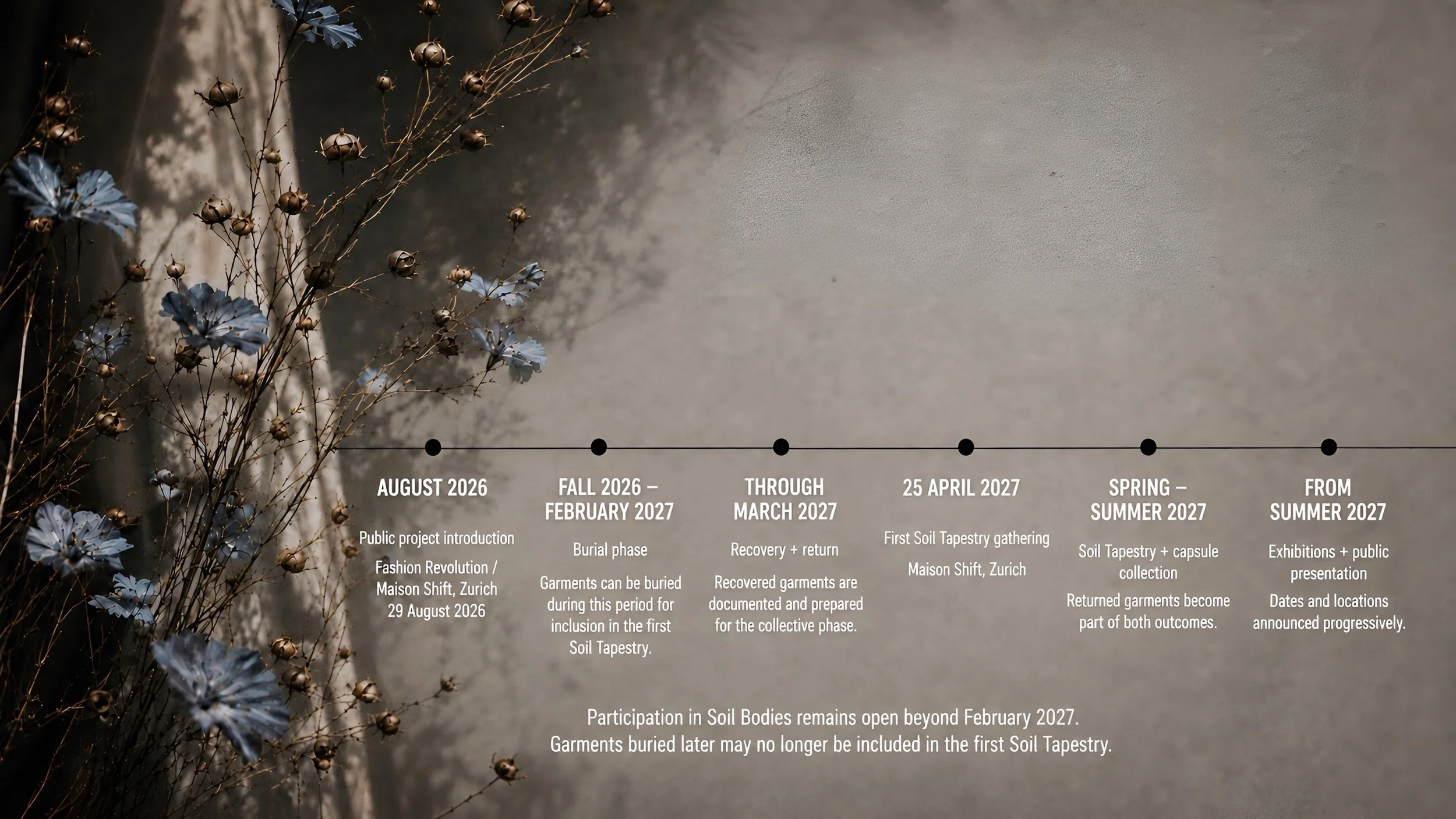
Project Timeline
Soil Bodies - The Living Tapestry is a project developed and led by Edie Lou Studio within the framework of SOILSCAPE. Unless otherwise stated, the project concept, artistic, and educational framework, methodology, teaching materials, Personal Soil Report (PSR), Material ID system, visual materials, photographs, documentation, and other original project content are developed by Edie Lou Studio (ELS). Scientific, technical, and institutional contributions by collaborators and partner organisations are acknowledged where applicable and remain subject to their respective rights. All rights reserved.
Collaborators & Funding