
Throughout history, clothing has existed alongside periods of conflict, humanitarian crises and profound societal transformation. Looking only at the twentieth century, one sees how inseparable fashion has always been from the world around it. During the two world wars, fabric shortages, rationing, and changing roles for women transformed clothing production and everyday dress. Before the First World War, particularly among the European middle and upper classes, women’s clothing was strongly influenced by conventions of femininity, social status, and propriety. Corsets, long skirts, and elaborate garments often reflected expectations about how women should present themselves in public. When millions of men were mobilized for military service, women entered or expanded their participation in occupations such as manufacturing, transportation, agriculture, and administration. Many working-class women had already been employed in these sectors before the wars, but wartime labor demanded substantially broadened women’s participation in certain industries. This, of course, affected fashion. First, clothing became more functional; second, traditional gender conventions were challenges; and third, fashion increasingly reflected women’s independence, freedom of movement, and changing participation in public life.
The second half of the twentieth century brought further social and political transformations. The civil rights movements of the 1960s, women’s emancipation, youth countercultures, the ideological divisions of the Cold War, and the political transformations of the 1990s profoundly influenced the relationship between society, identity, and fashion. In the United States, the struggle against racial segregation and discrimination also influenced appearance. During the Black Power movement, naturals hairstyles such as the Afro and African-inspired clothing became expressions of Black identity, cultural pride, and self-determinations. Appearance communicated a form of self-expression, constituted a semiotic language of political resistance, expressed opposition to racial oppression and discrimination while asserting collective identity, dignity, and demands for equality and freedom. At the same time, youth countercultures questioned traditional authority, social conformity, and established expectations surrounding gender and sexuality. The hippie movement of the 1960s challenged conventional dress codes through folkloric influences, traditional embroidery, flowing silhouettes, and gender-fluid dress, with long hair becoming a shared expression of freedom, pacifism, communal living, and resistance to consumerism. Punk emerged in the 1970s with a radically different attitude toward society and with it toward clothing. Torn T-shirts, distressed fabrics, safety pins, studs, chains, bondage trousers, leather, Mohawks, became part of a deliberately confrontational aesthetic. Rather than simply rejecting conventional fashion, punk dismantled and reconstructed its codes, appropriating elements of working-class dress, fetish culture, and political imagery. Through DIY practices, provocation, and the deliberate subversion of established symbols, punk turned appearance into a form of cultural dissent, confronting class hierarchies, social conformity, and the authority of the establishment.
The 1990s further demonstrated how different cultural and economic environments influenced fashion. Emerging from the alternative music scene of the American Pacific Northwest, grunge embraced flannel shirts, worn denim, oversized knitwear, a lot of holes, and secondhand clothing, reflecting youth disillusionment, anti-consumerist attitudes, and a rejection of polished mainstream aesthetics. Alongside grunge, the Riot Grrrl movement, brought renewed attention to feminism, gender inequality, sexual violence, and women’s autonomy, challenging sexism. The deliberately provocative aesthetics of the period became intertwined with emerging debates about political correctness. These developments formed part of a broader evolution of political and social consciousness. Within punk and hardcore subcultures, ideas surrounding political correctness - today woke - animal rights, veganism, environmental responsibility, and straight-edge lifestyles gained greater visibility, extending resistance beyond appearance into everyday choices and consumption. Fashion, music, and visual identity became interconnected expressions of political conviction, personal autonomy, and collective responsibility, demonstrating how cultural movements could challenge established values while developing alternative ways of living.
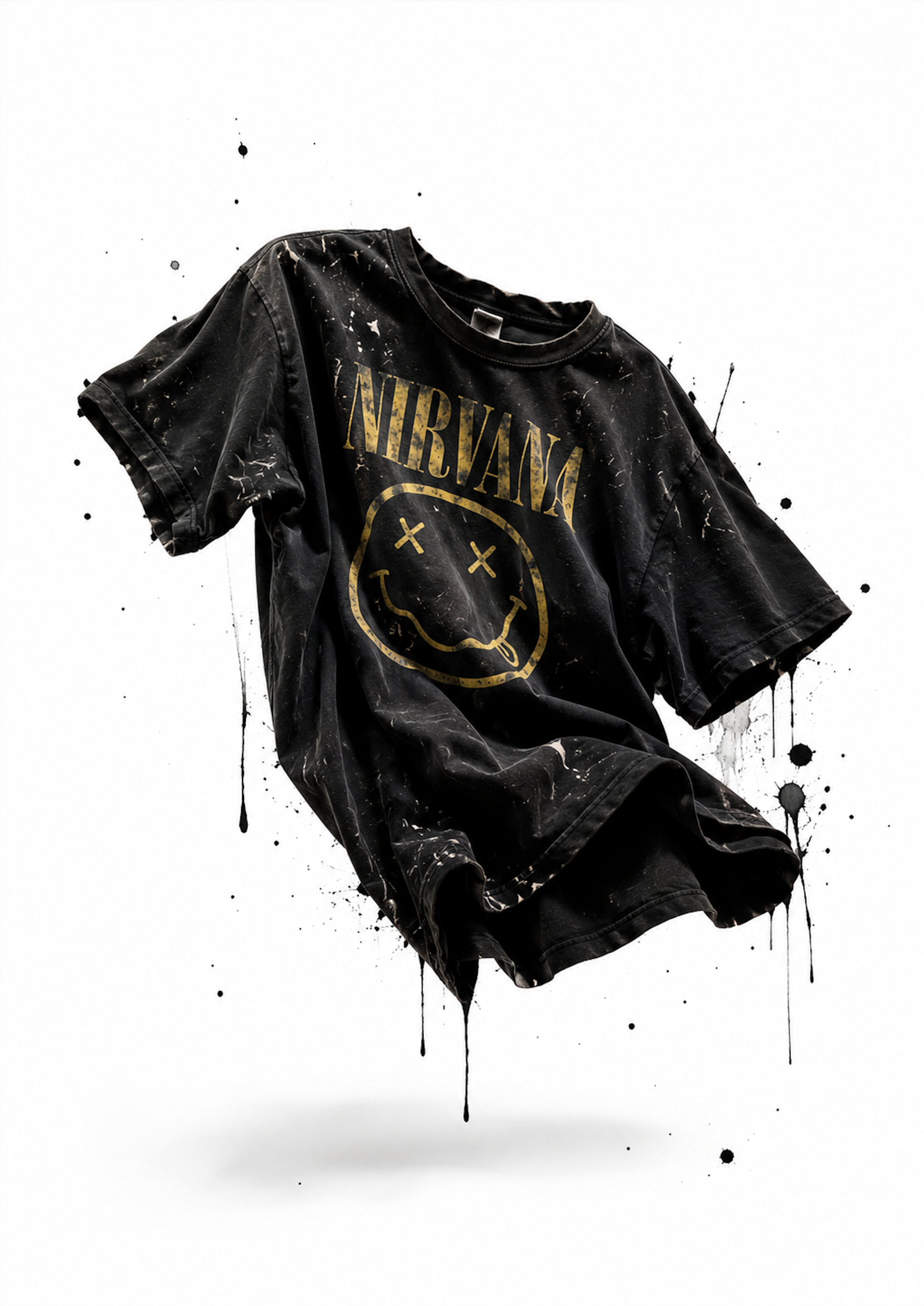
The 1990s further demonstrated how different cultural and economic environments influenced fashion. (@Edie Freisinger)
The Individual Within Society
The historical relationship between fashion and social change raises a fundamental question. Can we develop an independent sense of self while remaining connected to - and influenced by - the people and societies around us? We tend to think of our clothing, personal style, and aesthetic preferences as expressions of who we are. We believe we choose what we like because it reflects our individuality. But where do those preferences actually come from? And to what extent are they independent of the society in which we live? Let’s take another look at the historical movements mentioned earlier. In the 1970s, punk emerged partly as a rejection of established social conventions. Punk aesthetics communicated resistance, independence, and dissatisfaction with prevailing cultural and political conditions. These expressions of individuality, however, were themselves influenced by a particular social, economic, and cultural environment. What began as a rejection of mainstream expectations gradually developed into a recognizable aesthetic, creating a shared identity among individuals who sought to distinguish themselves from conventional society. This illustrates an important distinction: individuals may express genuine independence while using a visual language that has been collectively developed. Even rebellion is shaped by the circumstances against which it reacts.
The same principle applies to personal taste. Our understanding of what is beautiful, desirable, appropriate, or meaningful develops through education, cultural exposure, family environments, social relationships, and personal experiences. Someone growing up surrounded by experimental art, alternative music, and unconventional fashion may develop different aesthetic preferences from someone whose environment emphasizes traditional dress and established social conventions. Both may experience their choices as authentic expressions of individuality, although their preferences have developed through different cultural influences. This does not mean that personal taste is an illusion or that individual freedom is impossible. Rather, it suggests that our preferences can be genuinely personal without being entirely independent of our surroundings. The more interesting question is not where our preferences come from, but what we do with the influences that shape them. Do we consciously develop our own perspective, or simply adopt the expectations of people and communities around us? The distinction lies between being influenced by society and being governed by its expectations. Encountering unfamiliar ideas, artistic expressions, or cultural practices can expand individual perspectives and create new possibilities for personal development. By contrast, social pressure may restrict freedom when individuals feel compelled to conform out of fear of rejection or a need for external approval. Individual autonomy, therefore, does not require the absence of influence, it involves the capacity to openly reflect those influences, question established expectations, and make choices that correspond to one’s own considered values.
The individual is neither entirely independent of society nor simply a passive product of it. Identity develops through a continuous interaction between personal experience and the social environment. Clothing is among the most immediate forms through which individuals negotiate this relationship. Before verbal communication takes place, appearance already conveys information about identity, cultural affiliation, social position, and personal intention. Fashion operates simultaneously as an intimate experience of the self, and a publicly interpreted system of cultural signs. Yet the relationship between individuality and social influence, as we discussed, contains a contradiction. The German sociologist Georg Simmel examined this tension in his essay Fashion (1904), identifying imitation and differentiation as two fundamental tendencies within fashion. Individuals seek belonging through shared conventions while simultaneously attempting to distinguish themselves from others. Fashion accommodates both desires, allowing people to participate in recognizable collective identities while developing personal variations within them. What begins as an expression of opposition can become a shared cultural identity, and what initially appears unconventional may eventually establish new conventions.
Georg Simmel (@Edie Freisinger)
Trickle Up And Down - The Fashion Feedback Loop
This process illustrates how individual expressions of differentiation can develop into collective aesthetic preferences, which, in turn, influence the wider cultural environment. Fashion therefore operates through a continuous exchange between individuality and social recognition, in which styles emerge, circulate, and acquire new meanings as they are adopted by different communities. Yet this transformation reveals a fundamental paradox: when an expression of opposition becomes widely accepted, it gradually loses the very distinction through which it originally challenged established conventions. At the same time, its acceptance can indicate that the boundaries of what society considers appropriate, desirable, or acceptable have changed. What was once an act of resistance can become an ordinary part of everyday life, not necessarily because its original meaning has disappeared, but because the cultural environment itself has evolved - and opened up. The normalization of an unconventional aesthetic should therefore not automatically be interpreted as the failure of the movement from which it emerged. On the contrary, the disappearance of its provocative character can - and actually does- indicate that the movement has contributed to transforming the conventions it originally challenged. However, the commercial adoption of an aesthetic does not necessarily imply acceptance of the social values behind it. The aesthetic becomes commercially desirable, while the original social criticism may remain unresolved. The same mechanism can be observed among socially privileged groups, whose aesthetic preferences may initially serve to communicate exclusivity and distinction. The wider adoption of an aesthetic does not necessarily eliminate the social differences that originally gave it meaning. Owning the symbols - a Rolex, Chanel bag or a Mohawk - of a social class or group does not mean belonging to that specific group.
This relationship can also be observed in the ways fashion moves through society. Traditionally, fashion diffusion has often been explained through the concept of trickle-down, whereby styles associated with socially influential or economically privileged groups are gradually adopted by wider sections of society. This understanding is closely related to Simmel’s observations on imitation and differentiation. As particular styles become more widely accessible, their capacity to communicate social distinction may diminish, encouraging the emergence of new aesthetic preferences. However, cultural influence does not necessarily follow established social hierarchies. The concept of trickle-up describes the reverse process, in which aesthetic innovations originating in working-class communities, street culture, and alternative cultural environments are subsequently adopted by established fashion institutions. Punk provides a particularly revealing example, obviously. Its unconventional use of everyday materials, deliberately unfinished garments, and rejection of traditional aesthetic standards eventually influenced mainstream and luxury fashion. What initially communicated resistance to established conventions became part of the very cultural and commercial system it had challenged.
Despite their opposing directions, trickle-down and trickle-up share a fundamental social mechanism: the desire to establish or communicate distinction from particular social groups. Whether an aesthetic originates among privileged classes seeking to differentiate themselves from wider society, or within subcultures rejecting dominant conventions, clothing can serve as a means of establishing social boundaries and expressing collective identity. In both cases, the wider adoption of a particular aesthetic weakens its function as a marker of social distinction, prompting the original group to seek new forms of differentiation. The distinction lies in the social circumstances from which these aesthetics emerge, rather than in the underlying relationship between belonging and differentiation. This brings us directly back to Simmel’s observation that fashion simultaneously accommodates the desire for social affiliation and the desire for individuality. However, neither trickle-down, nor trickle-up, fully explain the complexity of cultural exchange. Fashion does not necessarily move in a single direction. Individuals, communities, artists, designers, and cultural institutions continuously influence one another, adopting and reinterpreting aesthetic expressions according to their own experiences and circumstances.
Contemporary digital communication has accelerated these exchanges, allowing cultural influences to circulate across geographical and social boundaries while enabling individuals to participate in several cultural environments simultaneously. Yet greater access to different cultural environments does not necessarily translate into greater individual independence. While contemporary society offers unprecedented opportunities to encounter unfamiliar perspectives, artistic expressions, and ways of living, it also exposes individuals to an expanding range of collective expectations. (Sidenote: Cultural influences crossing borders? Hardly a new thing. International magazines, television, cinema, and music have long contributed to the development of shard aesthetic languages beyond national borders. Particularly during the 1980s and 1990s, MTV, fashion publications such as i-D, The Face, and Dazed, alongside FashionTV were shaping international tastes long before Instagram. The early social networks, such as Friendster and MySpace, simply extended that exchange into the digital world. And YouTube, Facebook and Instagram? Not newcomers themselves. Facebook launched in 2004, YouTube in 2005, and Instagram itself is already 16 years old.)
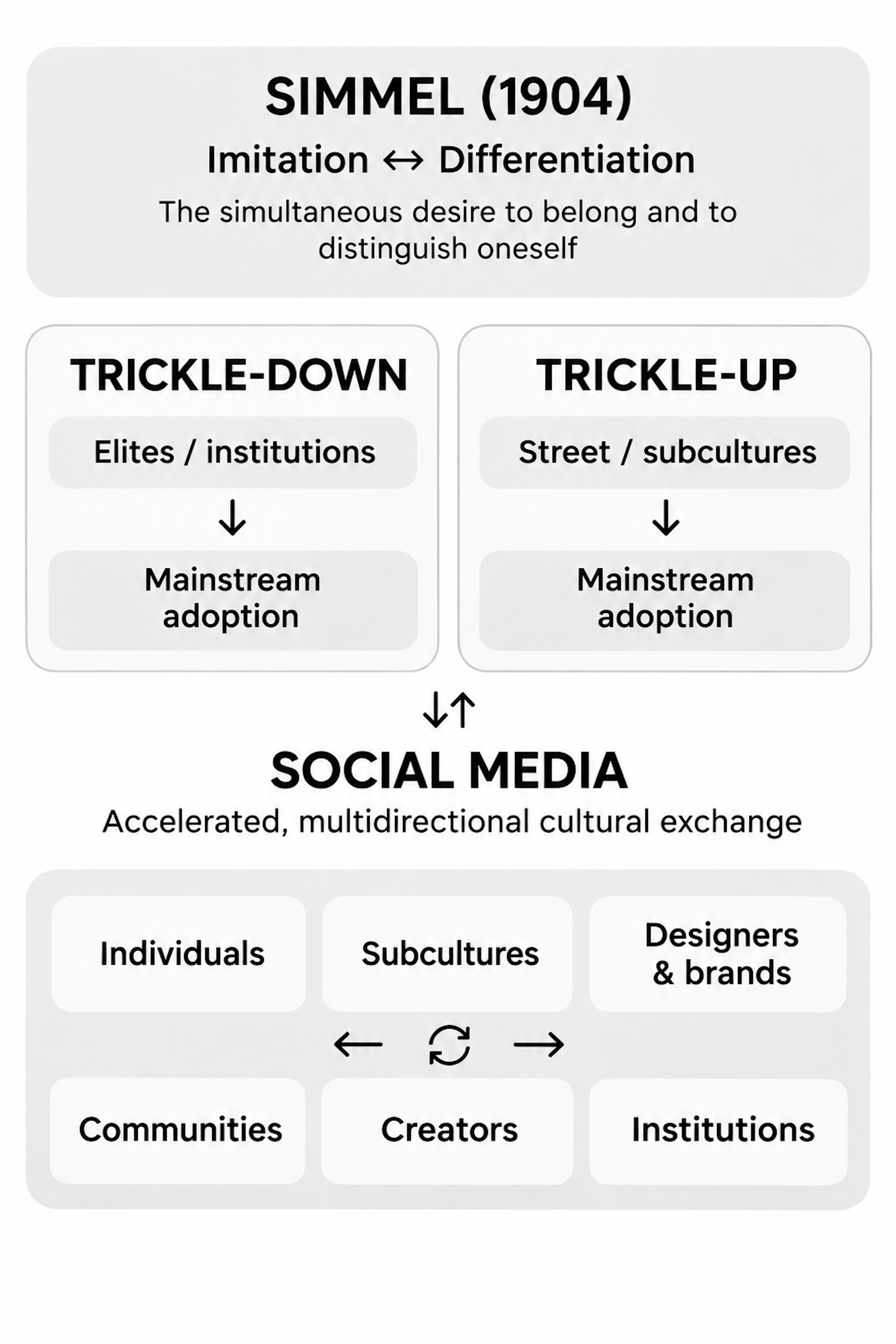
The fashion feedback loop (@Edie Freisinger)
So, all together, television, music, youth culture, zines, and later digital platforms have long contributed to the development of shared aesthetic languages beyond national borders. These media enabled individuals to encounter unfamiliar lifestyles, subcultures, and aesthetic perspectives beyond their immediate social environments, influencing how they understood and expressed their own identities. The subsequent development of the internet and social media expanded and accelerated these exchanges, while also allowing individuals to participate more directly in the production and circulation of cultural content. What distinguishes a particular historical period is therefore not simply the means through which cultural influences circulate, but the social, economic, and political circumstances in which individuals interpret and respond to them. Historically, established media institutions exercised considerable control over which aesthetics, artists, and cultural expressions reached international audiences. Digital, social platforms have lowered many of those barriers, allowing individuals and smaller communities to influence cultural developments without necessarily passing through traditional institutions.
Cultural influence has always been reciprocal and identifying precisely who initiated a particular aesthetic and why has often been difficult. This is not a new development. Even before mass media, styles circulated between social classes, geographical regions, artistic communities, and cultural institutions. The fundamental way people influence one another has not changed. What has changed is how easily, quickly, and widely that influence can circulate - and who has access to the means of distributing it. In the 1970s, a punk aesthetic emerging in London or New York might reach audiences elsewhere through concerts, photographs, zines, record shops, and television. This could take weeks, months, or longer. Today, a musician or independent artist can publish an image that reaches international audiences within hours or even seconds. The cultural mechanism is similar; the time required for diffusion has decreased. MTV and FashionTV already demonstrated that culture could circulate internationally. Millions of viewers encountered the same music videos, artists, and fashion aesthetics. The difference is that international distribution is no longer reserved primarily for organizations with substantial financial resources. An independent designer can potentially reach an international audience without first securing a television appearance or magazine feature. What changed is not the existence of international influence, but who can achieve it. And previously, reaching a large audience often required access to record labels, publishers, television networks, or established cultural institutions. Today, individuals can publish photographs, music, writings, and art designs themselves. An aesthetic originating in a small community can attract international attention before an established fashion institution adopts it. However, access to publishing is not the same as equal access to audiences. Money, algorithms, social networks, and institutional recognition still matter. The distribution of cultural influence has become less dependent on traditional gatekeepers, without necessarily eliminating the social hierarchies those gatekeepers represent - it does not necessarily dismantle existing social and economic hierarchies.

Human beings do not develop their identities in isolation. (@Edie Freisinger)
The individual, the Collective, and the Question of Freedom
The question of individual autonomy has occupied a central place in Western philosophical and cultural thought for centuries. From Enlightenment ideas of individual reason and self-determination to the emergence of modern individualism, the relationship between personal freedom and collective expectations has remained a persistent concern. Yet the ideal of an independent individual has always existed alongside the reality of social interdependence. Our tastes, identities, and forms of expression develop within cultural environments shaped by historical, social, economic, and political circumstances. Fashion makes these relationships particularly visible: what we wear can express belonging, solidarity, resistance, or simply an aesthetic preference, sometimes through the same garment - such as the punk leather jacket or the tartan skirt. While the desire for individuality and belonging has long shaped human cultural expression, the conditions under which these aspirations are negotiated have changed. Social media has accelerated cultural exchange, expanded opportunities for participation, and introduced new forms of visibility, recognition, and social influence. Social media platforms such as Instagram and TikTok allow individuals not only to encounter cultural influences but also to produce, distribute, and participate in shaping them. Yet the ability to express an opinion, adopt an aesthetic, or participate in a movement does not necessarily indicate independent judgment. Individual autonomy lies in our capacity to reflect upon these influences; question established expectations and make considered choices within a cultural environment that we ourselves help to shape.
And: human beings do not develop their identities in isolation. We seek connection, recognition, intellectual exchange, and shared experiences, and these relationships contribute to our understanding of ourselves and the world. The desire to belong, however, introduces a tension when acceptance within a community becomes dependent upon adherence to its expectations. Even groups that celebrate independence, experimentation, or opposition to established conventions do develop their own rules concerning appearance, behavior, and acceptable beliefs. Digital communities are no exception: their capacity to connect individuals across geographical boundaries can also expose them to collective expectations and pressures for approval. The speed at which opinions, images, and cultural movements circulate can intensify these pressures. leaving less time between encountering an idea and being expected to respond to it. What begins as an expression of freedom can consequently become another form of conformity. This does not diminish the importance of collective identity; autonomy does not require independence from the collective, but the capacity for independent judgment within it. Fashion, art, and music make this relationship particularly visible because they operate simultaneously as forms of personal expression and shared cultural language. It is a semiotic system through which individual expression and collective identity continuously influence one another. The meanings communicated through clothing emerge from shared cultural codes, yet they are neither fixed nor necessarily identical to the intentions of those who wear them. Individuals interpret, combine, and reinterpret these codes, contributing to their evolution while drawing upon them to express their own identities. Some choices are deliberate, others habitual or shaped by circumstances, but all take place within a cultural environment that we collectively sustain and transform.
But, as we mentioned, cultural influences do not simply restrict individuality; they also provide the knowledge, experiences, and relationships through which it becomes possible. We can be profoundly influenced by others without surrendering our independence, just as we can belong to communities without allowing them to define us entirely. Our need for autonomy is inseparable from our need for human connection. We seek to establish our own identities, yet we also depend on interaction, recognition, and shared experiences to understand ourselves and the world around us. The essential distinction lies between connection that expands our possibilities and conformity that restricts them. Whether fashion trickles down from established social hierarchies or rises from subcultures into the mainstream, the interplay between imitation and differentiation that Simmel described remains central to its development - the interplay between belonging and distinction. Fashion cannot resolve this tension, nor can it establish how free an individual truly is. But as an intimate expression of personal experience and visible language of collective culture, it reveals something fundamental about human existence: we seek the freedom to become ourselves while continuing the need to influence and be influenced by one another.
https://smg.media.mit.edu/library/Simmel.fashion.pdf
https://press.uchicago.edu/ucp/books/book/chicago/F/bo3777018.html
https://www.goodreads.com/en/book/show/464271.Fashion_ology
https://www.elizabethwilson.net/adorned-in-dreams/
https://www.erikclabaugh.com/wp-content/uploads/2014/08/181899847-Subculture.pdf
https://openlibrary.org/books/OL1122833M/Streetstyle
https://monoskop.org/images/1/19/Goffman_Erving_The_Presentation_of_Self_in_Everyday_Life.pdf
https://yalebooks.yale.edu/book/9780300199000/its-complicated/
https://www.goodreads.com/en/book/show/15931708-networks-of-outrage-and-hope
https://www.bloomsbury.com/us/introducing-fashion-theory-9781350091900/
https://diversityreadinglist.org/diffusion-models-and-fashion-a-reassessment/
https://onesearch.library.northeastern.edu/discovery/fulldisplay/alma9952195936701401/01NEU_INST:NUL
https://www.academia.edu/88783887/Authenticity_as_Performativity_on_Social_Media