
Sustainability is not a trend - whether we are tired of it or not; fatigue does not change ecological limits
Few concepts have become as ubiquitous - and as misunderstood - as sustainability. The term appears on product labels, in corporate reports, across marketing campaigns, and throughout public discourse. It is invoked by governments, fashion brands, retailers, investors, and consumers alike. One of the most persistent misunderstandings surrounding sustainability is the assumption that it belongs to the same category of phenomena as consumer preferences, cultural movements, or market trends. The language through which sustainability has been discussed has reinforced this misunderstanding. It began as a relatively serious scientific and political concept concerned with long-term ecological and social viability. The contemporary concept of sustainability developed through environmental science, systems research, and international policy during the 1970s and 1980s, when the relationship between economic expansion, finite resources, ecological degradation, and intergenerational responsibility became the subject of systematic analysis.
During the late 1990s and early 2000s, sustainability became increasingly integrated into corporate strategy. branding, product development, and consumer culture. Almost every company began using the term, often without changing the scale or structure of its operations. Sustainability became attached to collections, labels, packaging, and advertising, while production and consumption continued to expand. But, after years of corporate campaigns, ethical collections, certification systems, impact reports, and repeated appeals to responsible consumption, the concept slowly became semantically exhausted. As a result, the term became overused, weakened, and increasingly untrustworthy. Greenwashing was not a minor side effect; it changed how the public understood the entire concept. Sustainability came to signify corporate claims rather than measurable systemic change. Repetition produced fatigue, while the gap between communication and reality produced skepticism. And as we know, misleading environmental claims - or any claims - damage public trust.
So, the problem is not merely that people became tired of sustainability per se - sustainability was commercialized until its language lost credibility. What began as a framework for understanding ecological limits was reduced to a marketable attribute and then diluted through excessive, vague, and often unverifiable use. Consumers have been exposed to a continuous stream of environmental claims while receiving little evidence that the underlying structure of production has changed accordingly. The result was not simply declining interest, but a broader loss of trust in the language itself. Sustainability has become associated with moral instruction and corporate self-presentation, while the acceleration of production and consumption has continued - and increased - largely undisturbed. This exhaustion is often interpreted as evidence that sustainability has passed as a cultural concern. Yet such a conclusion repeats the original misunderstanding. Public fatigue concerns the discourse surrounding sustainability, not the ecological conditions that made the concept necessary. People may become tired of labels, campaigns, and moralized consumer messaging, but environmental systems do not become less constrained when attention declines. Soil erosion, freshwater depletion, biodiversity loss, and climatic instability do not belong to the cycle of cultural enthusiasm and disillusionment. What has lost credibility is not ecological reality, but the inadequate language through which institutions attempted to represent it - it became exhausted precisely because it was reduced to trend language, while the material problem has intensified.

It became exhausted precisely because it was reduced to trend language, while the material problem has intensified (@Edie Lou Freisinger)
From Scientific Warning to Political Programme
Let’s see what happened exactly. During the 1970s and 1980s… Actually, before we dive deep into the 20th century we have to talk about Alexander von Humboldt. The intellectual foundations of sustainability reach much further back than the environmental debates of the twentieth century. At the beginning of the nineteenth century, Alexander von Humboldt, the Prussian naturalist, geographer, explorer, and one of the founders of modern ecological thought, described nature as an interconnected system. During his travels in Latin America, he documented how deforestation, intensive cultivation, and changes in vegetation could affect soil conditions, water availability, and local climate. His observation challenged the assumption that human societies acted upon a passive and inexhaustible environment. Instead, they revealed a dynamic system in which climate, vegetation, water, soil, and human activity are mutually dependent - and disturbing one part of the system can destabilize the whole. However, Humboldt did not formulate sustainability in its contemporary, political sense - obviously - but he provided an early ecological and systemic understanding of human-induced environmental change.
The sustainability discourse of the 1970s and 1980s translated such scientific insights into a broader framework concerned with resource limits, institutional responsibility, and intergenerational justice. The publication of Our Common Future in 1987 did not mark the beginning of environmental thought itself, but it established the formulation through which sustainability would enter mainstream international policy. The report of the World Commission on Environment and Development, chaired by the Norwegian politician and physician Gro Harlem Brundtland, gave this discussion an important political dimension by linking environmental protection with economic and social development. Its importance lay partly in its attempt to overcome the opposition between “the environment” and “the economy”. Rather than arguing that development should simply stop, it defined sustainable development as development capable of meeting present needs without compromising the capacity of future generations to meet their own. This formulation made sustainability politically powerful because it was broad enough to be accepted by governments, businesses, international organizations, and civil society. It did not present environmental protection as an isolated policy field, but as a condition that had to be integrated into the organization of development itself.
The political importance of the report lies in this integration. Environmental degradation could no longer be treated solely as a consequence to be repaired after economic activity had taken place; it had to be considered within decisions about energy, agriculture, industry, cities, trade, and resource use. Sustainability therefore entered public policy as a framework for examining the long-term compatibility of human development with ecological systems. Sustainable development was understood primarily as a framework for reorganizing economic and social development within ecological constraints, rather than as a quality to be attributed to individual products or a responsibility to be exercised principally through consumer choice. The report was concerned with questions such as how economic development could continue without degrading the ecological systems on which it depended. It was not mainly asking whether consumers should buy an “eco-friendly” shirt, choose recyclable packaging - if any - or express environmental responsibility through purchasing decisions. That product- and consumer-oriented interpretation became more prominent later, when sustainability moved into corporate strategy, advertising, labelling, and brand communication. The concept addressed the fundamental organization of societies and the conditions under which economic and social development and environmental integrity could coexist.
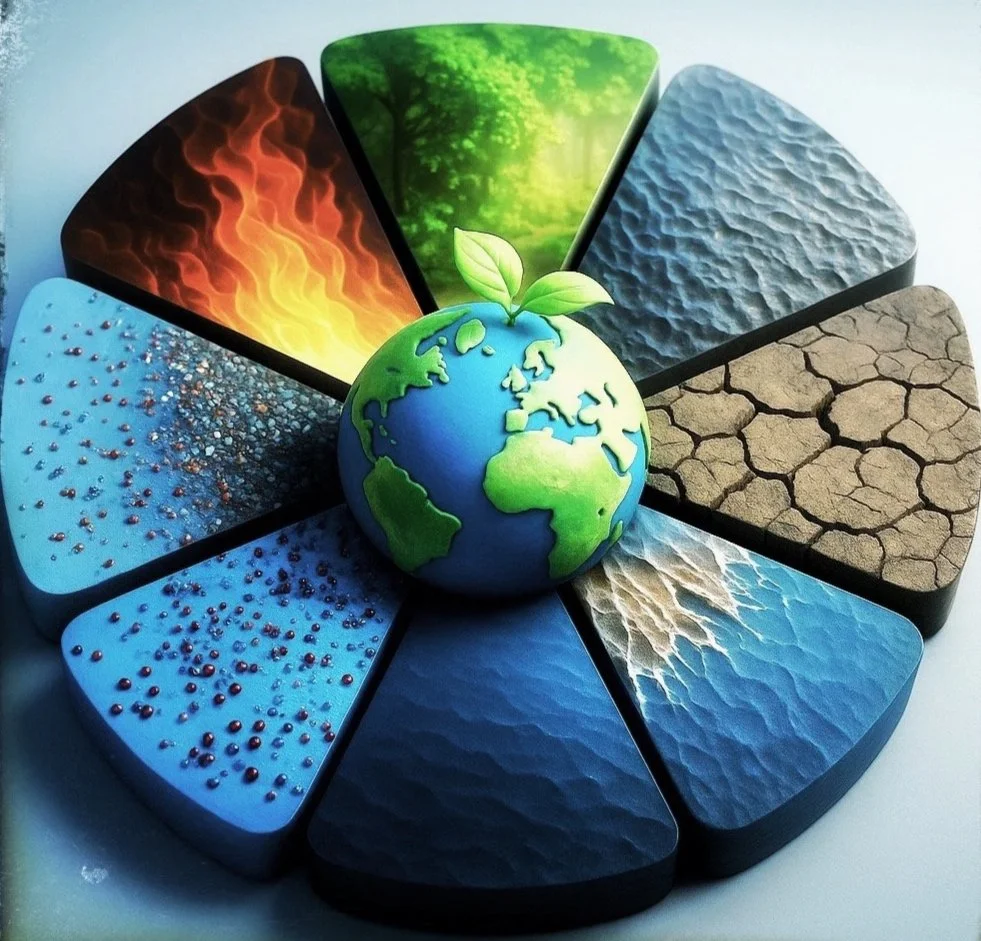
A dynamic system in which climate, vegetation, water, soil, and human activity are mutually dependent (@Edie Lou Freisinger)
From Political Framework to Public Fatigue
During the following decade, however, sustainability began to move from international policy into institutional administration. During the 1990s, the principles of sustainable development began to be incorporated into the formal practices of governments, international organizations, municipalities, and businesses through environmental policies, management systems, reporting frameworks, measurable targets, and institutional programs. Following the 1987 Brundtland Report, the 1992 United Nations Conference on Environment and Development in Rio de Janeiro - commonly known as the Earth Summit - translated sustainable development into a broader international policy program by developing several key documents, such as the Rio Declaration on Environment and Development, Agenda 21, the Convention on Biological Diversity, and the United Nations Framework Convention on Climate Change. It was one of the major moments when sustainable development moved from the general framework established in the Brundtland Report into international agreements and national policy. The historical change was concrete: sustainability was translated into local action plans, environmental departments, management standards, audits, certified systems, annual reports, and quantitative indicators. Agenda 21 asked national and local governments to turn sustainable development into practical programs. Local authorities were encouraged to consult citizens and prepare their own local Agenda 21 strategies. Municipalities began creating environmental action plans covering transport, land use, waste, water, energy, housing, and public participation. Sustainability therefore became something that could be assigned to municipal departments, connected to budgets, and monitored through local indicators.
At the European level, the Eco-Management and Audit Scheme, or EMAS, was introduced in 1993. It provided companies with a formal system for evaluating, reporting, and improving their environmental performance. A participating factory could identify its significant environmental impacts, establish objectives, collect data, undergo external verification, and publish an environmental statement. A broad principle concerning ecological responsibility was thereby converted into a repeatable management procedure involving audits, documentation, targets, and verification. A similar development occurred with ISO 14001, first published in 1996. The standard did not determine a universal level of environmental performance that every organization had to reach. Instead, it specified how an organization should construct an environmental-management system: formulate a policy, identify significant environmental aspects, consider legal obligations, establish objectives, document responsibilities, monitor performance, and pursue continual improvement. This is an especially clear example of sustainability entering institutional administration because environmental responsibility was reorganized into a management cycle that could be certified and incorporated into ordinary corporate governance. The Global Reporting Initiative (GRI), founded in 1997, created another form of operationalization. Companies increasingly disclosed information about emissions, energy, water, waste, labor practices, and other impacts through standardized reporting categories. Sustainability thus became something that could be organized into indicators and published in a report alongside financial administration. GRI describes its purpose as creating a common global language for reporting economic, environmental, and social impacts.

The commercial value of sustainability created a fundamental asymmetry (@Edie Lou Freisinger)
All these developments increased transparency and made previously neglected impacts more visible within corporate decision-making, but it also encouraged a managerial interpretation of sustainability: a company could adopt an environmental policy, define responsibilities, collect data, set targets, and undergo certification without being required to achieve a specific absolute reduction in total production. Therefore, the process did not necessarily demonstrate that the organization’s activities had become compatible with ecological limits. A company might reduce water use, energy consumption, or emissions per product, yet expand production so rapidly that its absolute resource use continued to rise. Relative efficiency and absolute impact were therefore not equivalent. A textile company that reduces water use from 100 to 80 liters per garment appears to have improved its environmental performance; however, if production increases from one million to 1.5 million garments, total water consumption rises from 100 to 120 million liters. The reported improvement is factually correct, but it does not describe the ecological outcome of the system as a whole.
Public concern about environmental damage created a new criterion by which products and companies could be read and judged. By the late 1980s, environmental issues were no longer confined to scientific or political debate. Pollution, toxic chemicals, waste, ozone depletion, deforestation, and acid rain had become highly visible public concerns. The Brundtland Report and the approach to the 1992 Rio Earth Summit also helped move environmental questions into mainstream political discussion. Environmental protection increasingly became part of how citizens judge governments, industries, and products. At the same time, consumer markets had become increasingly differentiated through branding. Companies were no longer competing only through price, function, and quality; they were also competing through values, identity, and reputation. Once environmental concern became socially important, it could be converted into a market signal. A product described as recyclable, biodegradable, ozone-friendly, or environmentally responsible could appear preferable even when its practical advantages were limited or poorly defined. This made environmental language commercially attractive because it offered companies a relatively inexpensive way to differentiate products - and gain reputational and commercial value. Changing labels, advertisement, packaging, or product claims was obviously much easier than restructuring production systems, reducing total resource use, or redesigning supply chains. Marketing could therefore respond to environmental concern more quickly than corporate operations could. The absence of clear standards made this even easier. Terms such as green, environmentally friendly, and biodegradable did not initially have consistent definitions or uniform evidentiary requirements. Companies could use broad claims that created a favorable impression without explaining precisely what had improved, relative to what baseline, or across which stage of the product’s life cycle. The Federal Trade Commission (FTC) later stated that environmental advertising had “mushroomed” in the late 1980s and early 1990s and that many claims appeared exaggerated, which is why it developed the first Green Guides in 1992 by the United States Federal Trade Commission for companies making environmental claims in advertising and on product labels. The guides explained how environmental claims should be qualified and supported by evidence so that they would not be deceptive under US consumer-protection law. Compared with the United States, Europe was slower to introduce specific, harmonized guidance for environmental marketing claims. Its early framework relied more heavily on voluntary certification - such as EU Ecolabel, introduced in 1992 -, general consumer law, and national enforcement, which left greater inconsistency in how vague green claims were interpreted and controlled.
During the 2000s and 2010s, sustainability became more deeply embedded in corporate and public language. In the European Union, the Non-Financial Reporting Directive of 2014 required certain large, listed companies, banks, and insurers to disclose information concerning environmental and social matters, human rights, and corruption. Sustainability was therefore no longer only voluntary communication; for major companies, parts of it were becoming a formal reporting obligation. At the international level, the adoption of the 17 Sustainable Development Goals in 2015 further expanded the language of sustainability. The concept now encompasses poverty, health, education, equality, economic growth, production, consumption, climate, biodiversity, and institutional cooperation. The SDGs provided a common vocabulary and a highly recognizable visual system of goals that could be used not only by governments and international organizations but also by universities, foundations, and corporations. During this period sustainability became increasingly integrated into brand identity, packaging, advertising, corporate websites, investor communication, and dedicated product ranges. The consumer was assigned a central role within this model. Environmental change was presented as something that could be advanced through informed purchasing: consumers would choose preferable products, markets would reward responsible companies, and corporate behavior would change accordingly. This interpretation transferred a substantial part of environmental responsibility from production systems to individual choice, even though consumers rarely possessed enough information to assess complete supply chains, absolute impacts, or the credibility of competing claims.
The commercial value of sustainability created a fundamental asymmetry. Transforming industrial systems was expensive, slow, and organizationally difficult. Changing production systems requires costly and often disruptive changes to business models, technologies, suppliers, materials, and volumes. For a fashion company, real transformation could mean replacing suppliers, changing fiber and chemical processes, redesigning products for durability and repair, reducing production volumes, improving wages and working conditions, shortening supply chains, investing in traceability, or accepting slower growth. These changes affect contracts, machinery, obviously costs, lead times, margins, and the entire business model. By contrast, changing the language through which those systems were represented was comparatively easy. Companies could rapidly alter how their environmental performance was presented by highlighting a limited material substitution, a packaging change, a pilot initiative. As a result, the public communication of sustainability often developed faster than the underlying transformation of production. A company could introduce one recycled material, redesigned packaging, launch a small “conscious” collection, announce a pilot recycling scheme, or set a net-zero target for 2024. Each of these actions might be genuine, but marketing could present it as evidence that the company as a whole was undergoing a comprehensive transformation, even though most of its production remained unchanged.

Sustainability itself, however, cannot become a fad (@ Edie Lou Freisinger)
Sustainability Is Not A Fad
By the end of 2010s and during 2020s, sustainability became progressively formalized through regulation: the Sustainable Finance Disclosure Regulation of 2019 extended sustainability reporting into investment markets and the Corporate Sustainability Reporting Directive of 2022 introduced more detailed corporate reporting obligations. At the same time, the EU adopted Directive 2024/825, restricting unsupported generic environmental claims and unreliable sustainability labels. Sustainability moved from voluntary corporate language toward formal reporting, financial classification, due-diligence requirements, product regulation, and stricter controls on environmental claims. At the same time, its widespread use in branding and marketing produced conceptual dilution, greenwashing, and public fatigue, creating a growing distinction between the loss of trust in sustainability discourse and the continuing urgency of the ecological conditions it was intended to address. Not to forget, that sustainability communication increasingly located responsibility at the level of individual consumption. Purchasing decisions were presented as mechanisms through which consumers could influence production systems, reward responsible firms, and accelerate environmental change. This model, however, assigned substantial interpretive and ethical responsibility to individuals while leaving the organization, scale, and incentives of production comparatively less visible. The consumer was expected to distinguish credible environmental performance from selective corporate representation within a market in which the producer largely controlled the available information.
But public fatigue developed from several interacting contradictions. It reflected not only distrust in repetitive and weakly substantiated corporate claims, but also the growing moralization of consumption within peer groups, families, workplaces, and social media. Purchasing decisions increasingly became interpreted as evidence of personal responsibility, political awareness, or ethical consistency. This social pressure encouraged consumers to demonstrate environmental concern through visible choices, yet the market frequently offered them simplified substitutes for structural change: a marginally improved product or collection presented as sufficient evidence for responsible consumption. But, let’s be honest, consumers were not merely passive recipients of this system. Demand influences production, and repeated purchasing sustains high-volume business models. Many consumers continued to buy large quantities of inexpensive clothing while accepting relatively weak environmental claims because this allowed consumption patterns to remain largely unchanged. Purchasing a low-cost product marketed as sustainable was economically easier - obviously - than buying fewer garments, selecting more durable and expensive products, repairing existing clothing, or abstaining from a purchase altogether. In this sense, sustainability marketing provided a form of moral reassurance: consumers could preserve the frequency and affordability of consumption while interpreting selected purchases as environmentally responsible.
This does not imply that consumers bear sole responsibility for production volumes, obviously. Prices, wages, availability, advertising, retail infrastructure, and deliberately accelerated product cycles all shape production. Nevertheless, consumer agency remains significant because repeated purchasing sustains high-volume production models. The point is not to assign moral superiority or blame to individual consumers, since a lot of us, me included, operate within the same economic and cultural system and are subject to its constraints.
So, the present fatigue surrounding sustainability is understandable, because the term has been overused, commercialized, and frequently detached from measurable change. Sustainability itself, however, cannot become a fad. Sustainability is not a cultural taste; it is the condition under which resource-dependent systems can continue functioning. Life itself - human economies included - require stable climate conditions. The intergovernmental Panel on Climate Change (IPPC) - the United Nations body that assesses scientific evidence on climate change, including its causes, impacts, future risk, and options for adaptation and emissions reduction - explicitly treats climate, ecosystems, biodiversity, and human societies as interdependent systems. The relevant limits are already being exceeded. The planetary-boundaries framework - Stockholm Resilience Centre - found six of nine boundaries transgressed in 2023; a 2025 update reported seven of nine, including climate change, biosphere integrity, freshwater change, land-system change, biogeochemical flows, novel entities, and ocean acidification. The consequences are real. The United Nations Convention to Combat Desertification (UNCCD) reports that up to 40 percent of the world’s land is degraded, threatening soil fertility, food security, biodiversity, and economic development. UN-Water reports that more than two billion people live in countries under water stress, while water scarcity intensifies as demand rises and supply becomes less reliable.
A fad becomes irrelevant when attention shifts; ecological dependence does not. Sustainability concerns the stability of the ecological systems that make life possible, including climatic regulation, freshwater cycles, fertile soils, biodiversity, and the functioning of terrestrial and marine ecosystems. Their degradation affects not only economic production or human welfare, but the survival of all species across the planet. If these systems are degraded beyond their capacity to recover, the consequences are not limited to higher prices, disrupted supply chains, or weaker economic growth. They place increasing pressure on the ecological conditions that support life and, ultimately, endanger our continued existence. So, public interest may decline and the language of sustainability may become exhausted, but the dependencies remain. Sustainability cannot become obsolete - it refers to the biophysical conditions required for the continuation of life on Earth. So, thank you, Humboldt, for pointing to this phenomenon two centuries ago. We have since spent an extraordinary amount of time pretending otherwise - but now is time to use that understanding finally constructively. How exactly? I cannot explain that in one sentence, nor do I claim to have the complete overview - none of us has - but having less, buying less, producing less, and being grateful for what we already have may be a good place to begin - without even having to call it sustainability.
https://www.are.admin.ch/en/1987-brundtland-report
https://www.un.org/esa/dsd/agenda21/
https://green-forum.ec.europa.eu/green-business/emas_en
https://www.iso.org/standard/23142.html
https://www.globalreporting.org/standards/
https://www.ftc.gov/news-events/topics/truth-advertising/green-guides
https://eur-lex.europa.eu/eli/dir/2014/95/oj/eng
https://sdgs.un.org/2030agenda
https://eur-lex.europa.eu/eli/dir/2022/2464/oj/eng
https://eur-lex.europa.eu/eli/dir/2024/825/oj/eng
https://environment.ec.europa.eu/publications/proposal-directive-green-claims_en
https://ui.adsabs.harvard.edu/abs/2004EcoEc..48..369R/abstract
https://www.nature.com/articles/461472a
https://energyhistory.yale.edu/w-stanley-jevons-the-coal-question-1865/
https://ui.adsabs.harvard.edu/abs/2015OrgEn..28..223L/abstract
https://ui.adsabs.harvard.edu/abs/2004EcoEc..48..369R/abstract
https://healthy.ucla.edu/wp-content/uploads/2019/12/Week-1-Steffen_PlanetaryBoundaries_2015.pdf
https://www.stockholmresilience.org
https://www.sciencedirect.com/science/article/abs/pii/S0304422X13000272